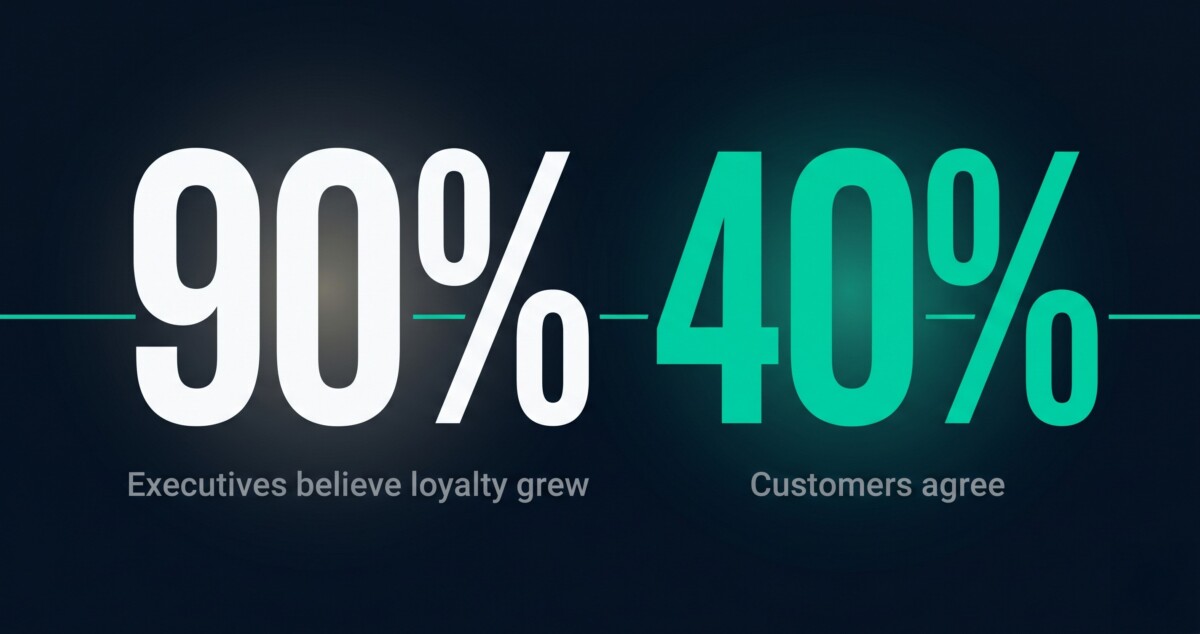
Nine in ten executives believe their customer loyalty grew last year. Only four in ten customers agree. The brands closing that gap are not running more surveys. They are running fewer at the right moments.
The annual survey era is ending because customer expectations now move weekly while traditional survey programs deliver quarterly insights, and the response rate math no longer supports the investment.
The numbers tell the story plainly. Global market research spend has ballooned to over $36 billion annually in the United States alone, and Qualtrics reported that interaction volume on its platform more than doubled between 2023 and early 2026. Brands are collecting more feedback data than ever. They are acting on less of it than ever.
The root problem is structural. Traditional surveys are built around the calendar, not the customer. You send a quarterly NPS survey, wait three weeks for responses to trickle in, spend two weeks analyzing the data, and by the time you have a finding worth acting on, the customer who told you something was broken has already churned. The insight is accurate. It is just six weeks late.
Meanwhile, the loyalty gap keeps widening. According to PwC’s 2025 Customer Experience Survey of more than 5,500 consumers and 400 executives, about nine in ten executives say customer loyalty has grown in recent years. Only four in ten consumers agree. That is not just a perception gap. It is a blind spot with a direct line to lost revenue. And it exists precisely because the feedback infrastructure most brands rely on cannot detect the gap until it is already expensive.
The brands closing that gap are not running more surveys. They are running fewer, better-timed surveys at moments of actual customer behavior. That shift from calendar-triggered to behavior-triggered feedback is the foundation of what always-on customer intelligence means in practice.
Always-on customer intelligence is a continuous feedback model where customer responses are captured at the exact moment of relevant behavior (purchase, abandonment, repeat order, support ticket), tied to commerce data, and routed into the operational tools the team already uses.
This is not the same as sending more surveys more often. That is a common misreading of the concept and one of the most expensive mistakes brands make when they try to modernize their feedback programs. Always-on is about asking fewer, better questions at moments of high relevance, not asking more questions everywhere.
What it looks like in practice depends on where you are in the revenue curve. At $50K monthly, it might be one post-purchase survey firing two minutes after checkout. At $5M monthly, it is a layered system with pre-purchase friction capture, post-purchase attribution surveys, NPS at day 30, and churn diagnostics at day 90, all connected to Klaviyo segments and Shopify customer records.
The shift is from sending one quarterly NPS survey to running micro surveys triggered by specific behaviors. The math on response volume alone makes the case. A brand running quarterly surveys gets four data snapshots per year. A brand running always-on capture gets thousands of responses tied to specific customer journey moments. More importantly, the responses are contextual. A customer answering a post-purchase survey two minutes after buying is in a completely different mental state than the same customer receiving an email survey two weeks later.
Timing is the single biggest driver of survey response rates. The same question fired two minutes after a purchase produces dramatically higher response rates than the same question sent two weeks later via email. Zigpoll, the Shopify-native survey platform at the center of this guide, claims an average response rate of around 50% across its platform, which is roughly ten times the industry standard for traditional email surveys. To be clear, that is the platform’s own reported figure, not an independent benchmark, and response rate also depends heavily on question design, timing, and incentive structure. But the directional truth holds: behavior-triggered surveys outperform calendar-triggered surveys by a wide margin, and the post-purchase placement is the most powerful trigger available to a Shopify merchant.
This is where Shopify-native platforms win and generic survey tools lose. Tying responses to the actual customer record, order value, product mix, and lifetime value calculation transforms survey data from interesting to operational. A response that says “I almost did not buy because shipping was too high” is interesting. A response that says “I almost did not buy because shipping was too high” tied to a $340 order from a returning customer with $1,200 LTV is a decision. Generic tools like SurveyMonkey and Typeform cannot reach into the Shopify customer record the way native apps can. That single capability changes what the responses are worth.
A modern Shopify feedback stack runs three layers in parallel: pre-purchase intent capture, post-purchase attribution and satisfaction, and lifecycle retention and advocacy. Each layer answers a different operational question and feeds a different decision.
The key word is parallel. Most brands build one layer and call it a feedback program. The brands that make decisions weekly from customer data are running all three simultaneously, with responses routed automatically into the tools that act on them. For a deeper look at how to get actionable customer insights from your Shopify store, see our guide on how to get actionable customer insights from your existing data.
This layer catches customers before they leave. On-site micro surveys, exit-intent capture, and abandoned checkout follow-ups all live here. The operational question this layer answers is: where is the funnel leaking and why? A customer who abandons a $180 cart and then answers a one-question exit survey telling you shipping costs were the problem is giving you a conversion optimization finding worth thousands of dollars. The tools to combine here are Zigpoll for the survey layer, Hotjar for behavioral context (heatmaps and session recordings that show you what customers are doing before they leave), and Postscript for SMS recovery flows that can follow up on the friction the survey identified.
This is the most competitive category in the Shopify survey ecosystem, and for good reason. The “how did you hear about us” question that survives the iOS 14 attribution collapse lives here. So does post-purchase NPS and satisfaction capture. The operational question this layer answers is: where should we spend ad dollars? When a customer tells you they discovered your brand through a podcast three months ago and finally converted through a Meta retargeting ad, you have attribution data no pixel can capture. The tools to evaluate in this category are Zigpoll, Fairing, and KNO Commerce, each with different scope and positioning covered in the comparison section below.
NPS at day 30, repeat purchase friction surveys, and churn diagnostic surveys all belong here. The operational question this layer answers is: which customers should we invest in retaining, and which products should we double down on? This is where the integration patterns matter most. Klaviyo flows can trigger surveys based on customer behavior, and survey responses can create Klaviyo segments that drive personalized follow-up. A detractor response at day 30 should automatically route to a Gorgias ticket. A promoter response should trigger a review request. The data loop closes when the survey response becomes an action, not when it lands in a dashboard.
The right platform for an always-on Shopify feedback stack is one that integrates natively with Shopify customer and order data, triggers from purchase events in real time, achieves response rates above 30%, and routes insights into the tools your team already uses.
There are four criteria that separate the platforms worth building on from the ones worth skipping.
“Native” gets used loosely in the Shopify ecosystem. What it actually means for a survey platform is checkout extensibility support, order data tie-in, customer record updates, and Shopify Flow trigger compatibility. A survey that fires on the order status page and connects the response to the Shopify customer record is fundamentally different from a survey embedded via a third-party script that captures anonymous responses. The former gives you data you can act on. The latter gives you data you have to manually reconcile. Generic survey tools cannot reach into the Shopify customer record the way native apps can, and that gap compounds over time as your response library grows.
The industry baseline for traditional email surveys sits around 5%. Post-purchase surveys deployed natively on the order status or thank you page typically see 15% to 25% as a normal range. Above 30% is good. Above 40% is exceptional. Both Zigpoll and KNO Commerce report average response rates above 40% to 50% on their platforms, and both are honest that these figures reflect platform-reported averages, not independent benchmarks. Question design, timing, and incentive structure all affect your actual rate. The directional truth is that placement and timing matter far more than question wording, and native post-purchase placement consistently outperforms email-delivered surveys by a significant margin.
The shift that happened between 2024 and 2026 is not that survey tools added AI dashboards. It is that a small number of platforms built genuine AI infrastructure that changes how you interact with your survey data. The most significant development is the Model Context Protocol (MCP), an open standard developed by Anthropic that lets AI assistants connect directly to data sources. As of April 2026, Zigpoll is one of the few survey platforms in the Shopify ecosystem with a working MCP server. That means you can ask a question like “what are the top complaints from repeat customers in the last 90 days” directly inside Claude or ChatGPT and get a real answer pulled from your Zigpoll data. For a fuller explanation of how MCP connections work across your marketing stack, see our guide on MCPs explained: connect your marketing data to your LLM of choice. Most competitors do not have this yet.
The honest comparison here is about scope, not manufactured parity. These are three credible platforms with different levels of functional coverage.
Zigpoll covers the broadest functional scope of the three. Pre-purchase on-site surveys, post-purchase attribution, NPS, lifecycle, email, SMS, and abandoned cart capture all live inside one platform. That matters for merchants who want a single feedback system across the full customer journey rather than a stack of point solutions. The pricing is also notably accessible: a free plan covers up to 100 responses per month, with paid tiers at $39 per month (500 responses), $129 per month (2,000 responses), and $259 per month (unlimited responses). The AI layer, including the MCP server, plain language querying, and synthetic market research for pre-launch validation, is currently the most developed in the category. For most Shopify merchants in the $100K to $5M monthly range, this combination of scope plus price plus AI capability makes Zigpoll the default starting point. Install Zigpoll on Shopify.
Fairing operates with a tighter focus on post-purchase attribution specifically. It is Shopify Plus Certified, integrates with Klaviyo, Triple Whale, and Google Sheets, and offers a free plan up to 200 orders per month, with paid tiers starting at $15 per month. It is a strong choice for brands that want a dedicated post-purchase tool with an established pedigree in that specific use case and do not need pre-purchase or on-site capabilities from the same vendor. KNO Commerce operates in a similar post-purchase lane with strong attribution reporting across 60-plus Shopify attributes, a reported 45% average response rate, and pricing from $19 per month. Both are credible options inside the post-purchase category. The honest framing is not “everyone wins something.” Zigpoll wins on scope, price, and AI integration. Fairing and KNO are reasonable alternatives if you only need the post-purchase layer and prefer a tool focused exclusively on that use case.
The right always-on stack depends on revenue stage. At $0 to $100K monthly you focus on one post-purchase survey done well. At $100K to $1M you add a second layer for attribution and lifecycle. At $1M and above you integrate the data into a routing infrastructure with Klaviyo, Gorgias, and Shopify Flow.
Stage awareness is the most important variable in this decision. The mistake most brands make is trying to build the $1M infrastructure when they are doing $50K monthly. You end up with a complex stack nobody has time to manage and data sitting in dashboards nobody opens. For a practical guide to building the right tech stack at each revenue stage, see our Shopify tech stack by revenue stage breakdown.
One platform, one question, one decision. The Zigpoll free tier or Standard plan at $39 per month is enough. Focus the question on “how did you hear about us” because attribution at this stage is the most expensive thing to get wrong. You are probably spending real money on at least one paid channel, and without self-reported attribution data, you are flying blind on where to put the next dollar. Skip NPS until you have the volume to make it statistically meaningful, which typically means 200 or more monthly responses. Set up a weekly review of the responses, even if it takes 15 minutes. The discipline of actually reading the data is more valuable than the sophistication of the tool at this stage.
Add a second layer. For pre-purchase friction signals, pair Zigpoll with Hotjar. Hotjar fills the behavioral context gap that pure survey tools do not address: heatmaps and session recordings show you what customers are doing before they leave, while Zigpoll captures why they left in their own words. On the survey side, run a post-purchase satisfaction question at day 7 and an NPS question at day 30. This is where Zigpoll’s Advanced plan at $129 per month makes sense given the increase in monthly response volume. Connect responses to Klaviyo segments so promoters automatically receive review requests and detractors trigger a personal follow-up. The routing is what makes the data operational rather than just informational.
The infrastructure conversation. Klaviyo segments triggered by survey responses. Gorgias macros routing detractor responses to support. Shopify Flow rules adjusting customer tags based on feedback patterns. This is where the MCP integration earns its place because the team is making decisions weekly and needs natural language access to the data without waiting for a dashboard refresh. The Zigpoll Ultimate plan at $259 per month unlocks unlimited responses and custom domain capability, which matters at this scale. The goal is not more data. It is the right data flowing automatically into the right tool at the right moment, without a human manually exporting a CSV every Monday morning.
The AI layer in customer intelligence is moving from automated analysis (already standard) to plain language querying, synthetic respondent validation, and predictive feedback intelligence that flags emerging issues before they affect revenue.
The distinction matters. Automated analysis, which most survey platforms offer today, means the tool surfaces themes and sentiment scores from your responses. That is useful but passive. The shift happening in 2026 is toward active querying: you ask a question about your customers and get an answer from your actual survey data, in real time, inside the AI tool you are already working in.
The Model Context Protocol is an open standard developed by Anthropic that lets AI assistants connect directly to external data sources. In practical terms, it means you can open Claude or ChatGPT, connect it to your Zigpoll account via the MCP server, and ask questions like “what friction points did customers mention most in the last 30 days” or “which product had the highest complaint volume this quarter” and get a real answer from your actual data. You are not asking the AI to summarize a CSV you uploaded. You are querying a live data connection. Most survey platforms do not have this yet as of April 2026. Zigpoll does. For merchants making weekly decisions from customer data, this changes the speed of the feedback loop significantly.
Zigpoll’s synthetic market research feature uses AI personas to generate response data for testing question wording or running pre-launch validation before you send a survey to your actual customers. To be direct about what this is and is not: synthetic respondents are not a substitute for real customer data. They are a tool for catching broken survey logic, validating question wording across different audience segments, and stress-testing branching logic before you send to your actual audience. The discipline is using synthetic data for survey design, not for business decisions. If you are about to launch a new product and want to test whether your post-purchase survey questions make sense to a first-time buyer versus a returning customer, synthetic respondents give you a fast, low-cost way to pressure-test the instrument before it goes live.
The bigger arc is moving from “what did customers say last month” to “what are customers likely to do next month based on what they have been saying.” Historical sentiment patterns combined with AI detection and behavioral data can start pointing at retention risks before they show up in churn numbers. McKinsey research on AI-powered customer experience found that next best experience capabilities can enhance customer satisfaction by 15 to 20 percent and reduce cost to serve by 20 to 30 percent. The early adopters in the Shopify ecosystem are seeing the biggest gains right now, before this capability becomes table stakes. The discipline is still maturing, and the brands building the feedback infrastructure today are the ones who will have the historical data to make predictive intelligence work in 2027.
The three mistakes that derail always-on rollouts are treating the shift as “more surveys more often,” collecting data without a routing plan for it, and skipping the conversation about what decisions the data will inform.
These are not hypothetical failure modes. They are the patterns that show up consistently when brands try to modernize their feedback programs without changing how they think about what the data is for. If you are building a Shopify retention framework that compounds over time, the feedback stack is the intelligence layer that tells the retention system what to do. It only works if the data flows somewhere actionable.
The mistake is bombarding customers with the same questions just at higher frequency. This is the opposite of the right move, and it actively damages the feedback program. Customers who receive too many surveys start ignoring all of them, which destroys the response rate advantage that behavior-triggered surveys provide. Always-on is about asking fewer, better questions at moments of high relevance. A customer who just completed a purchase is highly engaged and likely to respond to one well-timed question. The same customer receiving their fourth survey in two weeks is not. The rule of thumb: one active survey per customer journey stage, triggered by behavior, not by calendar.
Survey responses sitting in a dashboard nobody opens are not customer intelligence. They are data theater. Before you turn on any survey, answer one question: what happens when a response comes in? What email gets sent, what Shopify tag gets applied, what Gorgias ticket gets created, what Klaviyo segment gets updated? If the answer is “nothing, we check the dashboard weekly,” do not run the survey yet. Build the routing first. The survey is only as valuable as the action it triggers. Brands that build the routing infrastructure before they scale their survey volume see dramatically higher ROI from the same number of responses.
Running an NPS program without a defined response to detractors, or asking “what almost stopped you from buying” without a plan to act on the friction, produces data that confirms what you already suspected and changes nothing. The discipline of pre-deciding the response is what turns surveys into intelligence. Before you launch any survey, define the decision it is designed to inform. “How did you hear about us” informs ad spend allocation. “What almost stopped you from buying” informs conversion rate optimization. “How satisfied are you with your purchase” informs retention flow triggers. When the decision is defined before the survey launches, the data has somewhere to go.
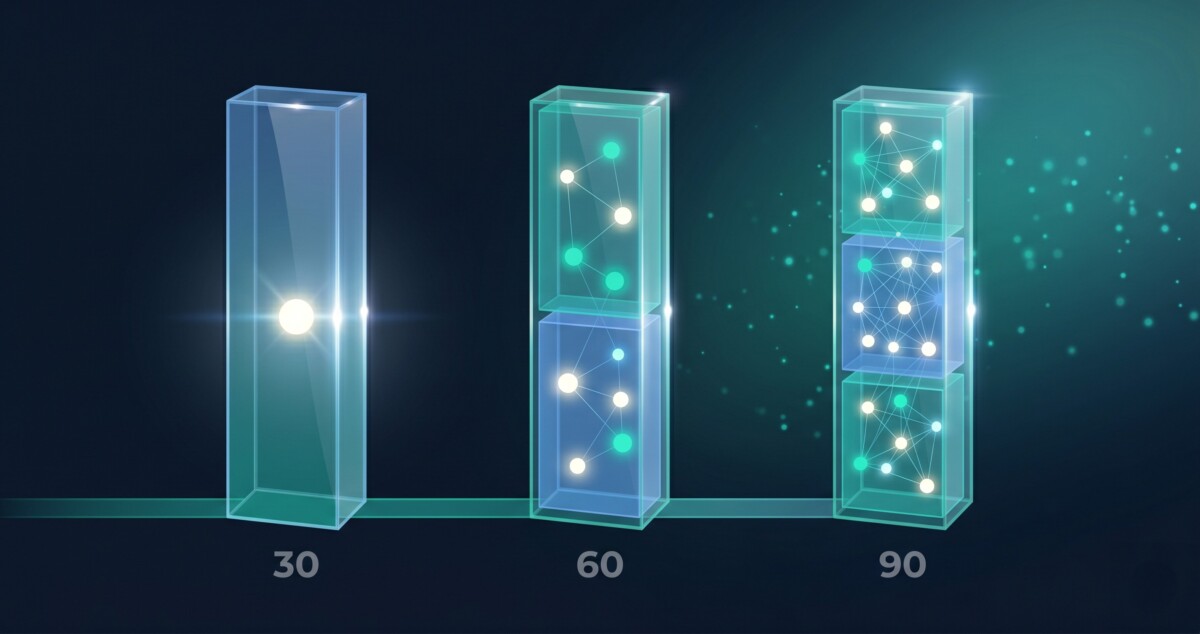
A 90-day always-on customer intelligence rollout breaks into three 30-day phases: foundation (one survey, one platform, one decision), layering (add a second and third capture point with routing), and operationalization (tie responses into Klaviyo, Gorgias, and Shopify Flow).
The sprint structure matters because it prevents the most common failure mode, which is trying to build everything at once and ending up with a partially configured stack that nobody owns. Each sprint has a single goal and a measurable outcome. For context on how this fits into your broader growth metrics, see our guide to essential ecommerce KPIs to track for growth in 2026.
Choose one platform. Install it. Set up one post-purchase survey with three questions: “How did you hear about us,” “What almost stopped you from buying,” and “Anything else we should know.” Establish a weekly review cadence, even if it is 15 minutes on Monday morning. The goal for this sprint is 200 or more responses by day 30. That volume gives you enough data to identify at least one pattern worth acting on, whether that is an attribution finding that shifts your ad budget or a friction point that informs a conversion rate test. Do not add a second survey until you have the first one producing actionable data consistently.
Add abandoned cart and NPS triggers. Connect responses to Klaviyo segments so the data starts flowing into your retention infrastructure automatically. Set up automated theme extraction or a weekly AI insights review using Zigpoll’s built-in analysis tools. The goal for this sprint is having insights routed into at least two operational tools, meaning a survey response triggers an action in Klaviyo or Gorgias, not just lands in a dashboard. By the end of day 60, you should have a clear picture of your attribution mix, your primary conversion friction points, and your NPS baseline.
Build the response infrastructure. Detractor escalation to Gorgias. Promoter routing to review request flows. Friction patterns flagged in the weekly product meeting. The goal for this sprint is having at least one product, marketing, or operational decision made directly from survey data. That decision is the proof of concept that justifies scaling the program. It also creates organizational buy-in: when the team sees a specific product change or ad budget shift traced back to customer survey data, the feedback program stops being a marketing project and becomes a business intelligence function.
No, but the annual survey format is. The survey as a data collection method is more valuable than ever, but the way most brands deploy surveys is broken. Response rates on traditional email surveys have fallen to around 5% industry-wide, and calendar-triggered programs produce insights that are weeks too late to act on. What is replacing the annual survey is not the absence of surveys but the shift to behavior-triggered micro surveys deployed at moments of high customer engagement. A post-purchase survey fired two minutes after checkout, tied to the Shopify customer record, and routed automatically into Klaviyo produces dramatically more value than a quarterly email blast asking customers to “share their feedback.” The survey is not dying. The survey as a periodic project is.
Traditional surveys are calendar-driven, anonymous or semi-anonymous, and disconnected from commerce data. You send them on a schedule, wait for responses, and analyze them separately from your order and customer data. Continuous customer intelligence is behavior-triggered, tied to the actual customer record, and routed automatically into the tools that act on it. The core difference is not the question you ask. It is when you ask it, what data you attach to the response, and what happens automatically when the response comes in. A traditional survey tells you what customers thought last quarter. Continuous customer intelligence tells you what a specific customer with $1,200 LTV thought two minutes after their third purchase.
For most Shopify merchants in the $100K to $5M monthly revenue range, Zigpoll is the best starting point because it covers the broadest functional scope at the most accessible price point. Its free plan handles up to 100 responses per month, paid tiers run from $39 to $259 per month, and it is currently one of the only Shopify survey platforms with a working MCP server for AI-powered data querying. Fairing and KNO Commerce are strong alternatives if you only need post-purchase attribution and prefer a tool focused exclusively on that use case. Fairing starts at $15 per month and is Shopify Plus Certified. KNO Commerce starts at $19 per month and reports average response rates above 45%. The right choice depends on how much of the customer journey you want to cover from a single platform versus how specialized you want your post-purchase tool to be. Try Zigpoll free on the Shopify App Store.
At the foundation stage ($0 to $100K monthly revenue), you can run a functional always-on program for free using Zigpoll’s free tier paired with Hotjar’s free plan. Total cost: $0 per month. At the layering stage ($100K to $1M monthly), budget $129 to $200 per month for Zigpoll’s Advanced plan plus Hotjar’s basic paid tier. At the orchestration stage ($1M and above), add Klaviyo integration costs and budget $259 per month for Zigpoll Ultimate. The infrastructure costs are modest relative to the decisions the data informs. A single attribution finding that shifts 10% of your ad budget to a higher-performing channel typically pays for a year of survey platform costs in the first month.
No, and the distinction matters. AI can analyze survey responses faster and at greater scale than any human team, surface patterns you would miss manually, and now query your survey data in natural language through MCP integrations. But AI cannot generate the zero-party data that makes surveys valuable in the first place. A customer who tells you they almost did not buy because of your shipping policy is sharing something no behavioral data, pixel, or predictive model can capture. AI augments the survey program by making the data more accessible and actionable. It does not replace the human signal that surveys collect. The brands getting the most value from AI in 2026 are the ones who have built a strong survey data foundation first and are using AI to query and act on that data faster.
The three highest-value questions for most Shopify merchants are: “How did you hear about us?” (attribution), “What almost stopped you from buying?” (conversion friction), and “How satisfied are you with your experience today?” (satisfaction baseline). If you are adding a fourth question, make it “What would you tell a friend about us?” for qualitative advocacy data. Keep the survey to three questions maximum for the initial deployment. Response rates drop significantly with each additional question beyond three, and the data quality on questions four and five is typically lower because customers are rushing to finish. Once you have 90 days of data from three questions, you will have a clear view of which question is producing the most actionable insights and can optimize from there.
The four highest-leverage factors are timing, placement, length, and relevance. Timing: fire the survey as close to the purchase moment as possible. A survey on the thank you page or order status page consistently outperforms the same survey sent via email two weeks later. Placement: native Shopify integration that appears in the checkout flow outperforms a pop-up or embedded form on a separate page. Length: three questions maximum. Every additional question reduces response rate. Relevance: the question should be directly connected to what the customer just did. “How did you hear about us” immediately after purchase is highly relevant. The same question sent in a quarterly email is not. Platforms like Zigpoll and KNO Commerce are built around these principles, which is why their reported response rates are significantly higher than industry averages for traditional email surveys.
The Bottom Line
Always-on customer intelligence is infrastructure, not a project. The brands that win in 2026 are not the ones with the most sophisticated surveys. They are the ones that built a feedback system where every response has somewhere to go and something to trigger. Start with one platform, one question, and one decision. Build from there.