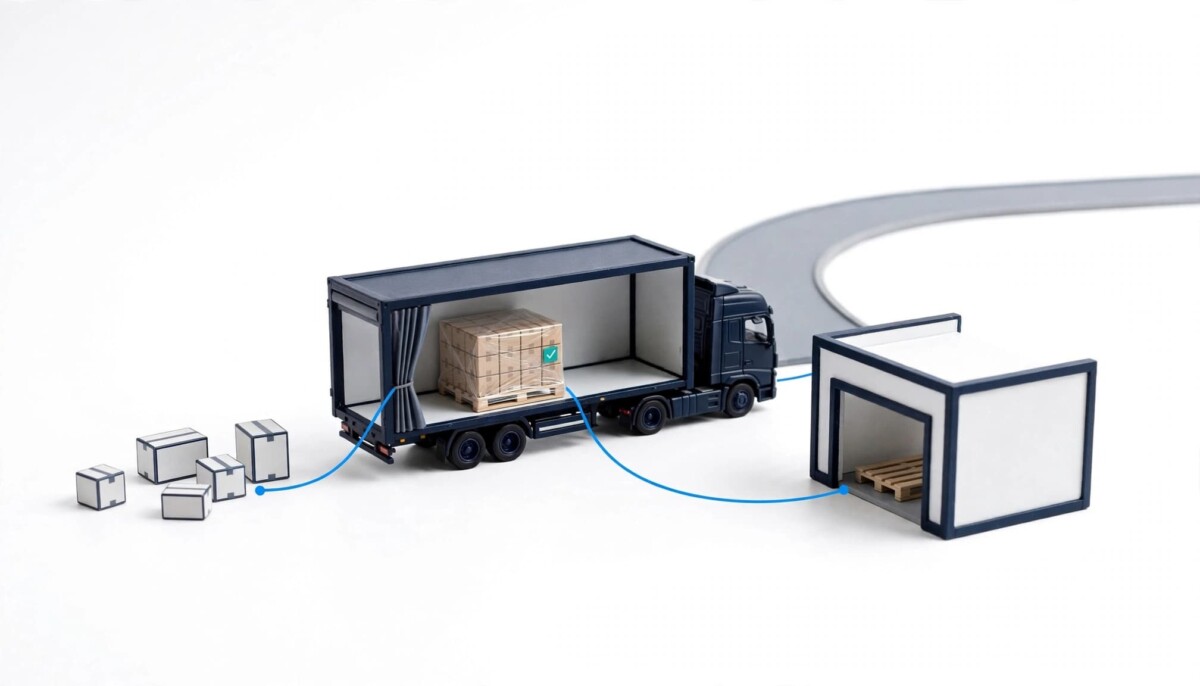
UK retailers should move from parcel carriers to pallet or part-load road freight once they regularly ship heavy, bulky, or multi-carton orders to the same destinations, and should line up a Clean Air Zone compliant haulier whose depot reaches their main routes the same day, before volume forces the decision.
The carrier that worked fine at 20 orders a day rarely fails loudly at 200. It fails one lost pallet, one missed delivery window, and one surprise surcharge at a time.
You’ve cracked the paid ads. Orders are coming in. The Shopify dashboard is doing something genuinely exciting.
Then you ship a hundred orders in a week and realise your current logistics setup isn’t built for what you’re becoming.
This is the moment many UK ecommerce operators hit a wall. The parcel carrier that worked fine at 20 orders a day starts to struggle at 200. Parcels go missing. Delivery windows slip. Customer complaints start arriving faster than you can answer them.
Getting UK haulage support for growing retailers right is not a back-office problem. It is a growth lever. The businesses that scale smoothly are the ones that build the freight relationship before they need it urgently, not after something breaks.
Parcel carriers stop making sense when you regularly send heavy goods, bulky items, or several cartons to the same destination, because per-item pricing grows with every box while a pallet or part load is priced by the space and weight it takes on a vehicle. A common rule of thumb in haulage is that the maths starts to change once you are regularly filling half a van or more.
Every UK ecommerce business starts with a parcel carrier, and that is the right call. Volumes are small, goods are light, and there is no minimum commitment. You pay per item and move on. The problem is that per-item pricing compounds. At low volumes it is invisible. At scale it becomes one of your biggest cost lines, and it hits hardest on exactly the orders that matter most as you grow: the wholesale reorder, the stockist’s opening order, the trade account buying by the case.
Here is how the comparison works. Illustrative example only, assuming a retailer sends 40 cartons of 15kg each to one stockist’s warehouse, a parcel rate of £9 per carton, and a quoted next-day pallet network rate of £95 for one standard pallet holding all 40 cartons. The parcel route costs £360; the pallet route costs £95, and the goods arrive as one consignment rather than 40 separate tracking numbers. Your real rates will differ, so plug in your own invoices and two or three haulage quotes before you decide anything. The point is the shape of the maths: parcel cost rises in a straight line with every box, while pallet cost rises in steps.
There is also a service reason. Parcel networks are built for volume across their whole customer base. They are not built around your specific freight. A road haulage partner moving your consignment has one job: get your goods there on time and undamaged. If you sell anything heavy enough that a checkout shipping calculator starts losing orders, the delivered cost math trade buyers run before they compare price is worth reading alongside this.
UK pallet networks are growing steadily and holding service levels around 96%, which makes palletised road freight a mature, well-run option for ecommerce retailers rather than a fallback for businesses that cannot afford couriers.
According to the Association of Pallet Networks, more than 14.9 million pallets were delivered across UK pallet networks in the first half of 2025, up 2.7% on the same period in 2024, with next-day volumes up 2.8%. The association’s later update put the figure at more than 22.6 million pallets moved by the eight ambient pallet networks to the end of September 2025, up 2.3% year on year, with 96% of consignments delivered within their specified criteria.
That 96% is the number to hold onto. It tells you a pallet network is a dependable channel for the part of your business that ships in bulk. It does not tell you how any single network or member depot will perform on your routes, which is why the questions later in this piece still matter.
For Shopify merchants shipping into retail, wholesale, or B2B channels, palletised freight is often the format the customer expects. Many retail distribution centres book deliveries into slots and receive goods on pallets, so a brand that turns up with 40 loose parcels from three different vans creates work for the buyer’s goods-in team. A pallet protects goods better, handles larger consignments cleanly, and scales without the cost spikes that come with per-parcel pricing. If you are about to pitch stockists, the section on whether you can ship like a wholesale vendor covers the case packs, minimums, and lead times buyers check alongside delivery.
Yes, because a haulier based in the Midlands sits inside a short drive of most of Britain, so it can collect in the morning and deliver to most major cities the same day in a way a carrier in a regional corner of the country often cannot.
The UK road network is not symmetrical. The Office for National Statistics describes the West Midlands “golden logistics triangle” as being within a four-hour drive of 90% of the British population. Birmingham sits where the M6, M5, M42, and M40 come together. If you are shipping nationally, you want your freight partner within striking distance of that central corridor.
That is not a geography lesson. It has practical consequences for your customers. A haulier operating from the Midlands can pick up this morning and reach Manchester, Bristol, London, or Leeds today. One based on the south coast or in the far north can do some of those runs well and others only with an overnight stop or a handover to another depot, and every handover is a point where a pallet can be delayed or damaged.
Location matters less if your stock and your customers sit in the same region. A Glasgow brand selling mostly into Scotland may be better served by a strong Scottish carrier than by a Midlands one. The test is your own data, not the map.
So run the test. Ask any haulier you are considering where their depot is, then map the drive times from that depot to your top ten delivery postcodes from the last quarter. If more than two or three of those routes need an overnight stop or a third-party handover, keep looking or ask how they cover those lanes.
Book a full load when you have a large, regular consignment going to one destination or a strict delivery window to hit; book a part load when your volume does not fill a vehicle but is too big for parcel carriers to handle cleanly.
This is where a lot of growing retailers overspend. A full load means your goods fill the vehicle, and you pay for the whole truck. A part load, sometimes called groupage, means your consignment shares a truck with other freight heading the same way, and you pay for the space you use. Both are standard, and both have their place.
Full loads make sense when you have a large, regular consignment going to a single destination, when your goods are time-critical or high value, or when you are delivering to a retailer with strict booking windows. Part loads make sense when your volumes do not fill a vehicle but exceed what parcel carriers handle cleanly, when you are sending to multiple destinations on a shared route, or when cost per pallet matters more than having the truck to yourself.
A good haulier will tell you honestly which you need. One pushing you towards a full load when a part load would do the job is one to watch. Ask them to price both and explain the difference in transit time and handling, then decide for yourself.
Before you sign with a haulier, ask about fleet emissions compliance, quote speed, customs capability, the damage claims process, and whether they can store goods as well as move them, because a rate card alone tells you nothing about how the relationship holds up under pressure.
Most freight relationships begin with a quote request and end with a rate card. That is not enough due diligence. Start with the vehicles. Ask what they run and whether the fleet is Clean Air Zone compliant, because several English city centres now charge non-compliant vehicles to enter, and if your haulier cannot reach Birmingham or Bristol without a charge, that cost will appear on your invoice eventually. The next section covers which cities and which vehicles.
Then ask how quickly they can quote. For time-critical shipments, a response within the hour matters more than a slightly lower rate that arrives tomorrow. Ask whether they handle customs clearance. If you import stock before it moves to customers, a freight partner that combines haulage with customs work removes a real admin burden and one more handover between companies.
Ask what their damage claims process looks like. Every freight provider will tell you damage is rare. Ask what happens when it isn’t: who you call, what evidence they need, how long settlement takes, and what liability limit applies per kilo or per pallet, because standard carrier liability is often well below the retail value of what you ship.
Finally, ask whether they can combine warehousing with transport. If your growth means you need storage as well as movement, a partner offering both under one roof cuts coordination time and cost. It also concentrates risk, so ask how that building is protected; the risks behind facility reliability in ecommerce fulfilment apply to any warehouse your stock sits in, whoever runs it.
Clean Air Zones charge non-compliant vans and lorries a daily fee to enter several English cities, and hauliers usually pass that fee on as a surcharge, either itemised or quietly built into the rate, so a non-compliant fleet raises your delivery costs on every run into those cities.
This one catches retailers off guard. According to the government’s guidance on driving in a Clean Air Zone, charging zones currently operate in Bath, Birmingham, Bradford, Bristol, Portsmouth, Sheffield, and Tyneside (Newcastle and Gateshead). Most of them charge both non-compliant vans and heavy goods vehicles; Portsmouth’s zone covers lorries but not vans. London runs its own separate Ultra Low Emission Zone and Low Emission Zone with their own rules and charges.
The standard to ask about depends on the vehicle. Diesel vans must meet Euro 6 to enter without a charge, and lorries must meet Euro VI, the heavy vehicle equivalent. Any haulier worth working with runs a compliant fleet and can tell you so in one sentence.
So ask explicitly, and ask it in writing as part of the quote. A provider that cannot confirm their fleet standard is telling you something about how they manage their own operation. And if your biggest customers or stockists sit inside one of these zones, ask the haulier to show how the charge, if any, would appear on your invoice before you send the first consignment.
Build the freight relationship while things are going fine, before a peak or a big new account, because a haulier you have already tested is a completely different resource from one you are cold-calling on a Friday afternoon after your usual carrier has lost a pallet.
The retailers that handle freight well share one habit: they find a logistics partner before they are under pressure. Start the conversation early. Run a small consignment before it matters. Ask questions the way you would with any supplier you plan to grow with. International Forwarding, the Birmingham haulier that contributed this piece, has operated since 1989 and says it works with more than a thousand UK businesses, from FMCG to aerospace. Whoever you choose, a partner with that kind of history has usually seen most of what you are going to run into.
Timing matters because growth in UK ecommerce is not slowing. IMARC Group values the UK ecommerce logistics market at about $17.4 billion in 2025 and forecasts growth of roughly 6.2% a year through 2034. Treat that as a market research forecast, not a guarantee, but the direction is clear: more retailers selling more goods to more customers means more freight competing for the same vehicles, especially in the run-up to Christmas.
That last point is where a late decision gets expensive. Peak season is the worst time to discover your freight setup cannot cope, and if you are already planning your BFCM shipping and tracking fixes, your bulk and wholesale freight belongs in the same plan.
The logistics partner that earns your repeat business is rarely the cheapest. It is the one that answers the phone, quotes fast, and delivers reliably.
What you do first depends on how much of your volume ships in bulk: early-stage retailers should benchmark, growing retailers should test a pallet route, and established retailers should formalise freight terms before the next peak.
If you are doing under £20K a month and shipping mostly single parcels to consumers, stay on parcel carriers and negotiate those rates. Do one thing now: tag every order over 20kg or over three cartons in Shopify for a quarter, so you know when the crossover is coming instead of guessing.
If you are doing £20K to £200K a month, or you have just landed your first stockist or wholesale account, get three part-load and pallet network quotes for your top two bulk routes and run one test consignment. Compare the landed cost per unit against your parcel invoices, using the same arithmetic as the illustrative example above.
If you are above £200K a month with regular retail or B2B volume, you probably already use pallets. The work now is formal: confirm fleet compliance in writing, agree liability limits and claims timelines, decide whether storage and transport should sit with one partner, and book capacity for peak before your competitors do.
The question at every stage is the same. Not whether your logistics will need to scale, but whether your current setup can handle it when the time comes. Build the freight relationship now. Test a route. Know your options. Then scale.
A UK ecommerce store should price pallet delivery, and usually switch to it, for any order type that regularly sends heavy goods, bulky items, or several cartons to the same address. Parcel pricing charges for every box, while a pallet is charged for one consignment, so the saving grows with each extra carton. Single consumer orders usually stay with parcel carriers. The practical test is to pull 90 days of orders, flag those over about 20kg or three cartons going to one destination, and price those routes with two or three pallet network quotes. If bulk orders are a growing share, run a test consignment before your next big wholesale or retail order.
A full load means your goods fill a whole vehicle and you pay for the entire truck, while a part load, also called groupage, shares the vehicle with other customers’ freight and you pay only for the space you use. Full loads suit large, regular consignments to a single destination, time-critical deliveries, and retailers with fixed booking slots. Part loads suit retailers whose volume is too big for parcel carriers but does not fill a truck, or who send to several destinations along the same route. Ask any haulier to price both options and explain the difference in transit time and handling before you choose.
Clean Air Zones can affect what you pay for freight, because non-compliant vans and lorries are charged a daily fee to enter the zone and hauliers usually pass that fee on. Charging zones currently operate in Bath, Birmingham, Bradford, Bristol, Portsmouth, Sheffield, and Tyneside, and London runs its own separate emission zones. Diesel vans need to meet Euro 6 and lorries Euro VI to avoid the charge. Ask every haulier to confirm in writing that their fleet meets these standards, and ask how any charge would appear on your invoice if a vehicle on your job is not compliant.
Your haulier’s depot location matters because it decides how many of your delivery routes can be completed the same day without an overnight stop or a handover to another carrier. A depot in the West Midlands “golden logistics triangle” sits within a four-hour drive of 90% of the British population, according to the Office for National Statistics, which makes it well placed for national delivery. A regional carrier may suit you better if most of your customers are in the same region. Map drive times from each candidate depot to your top ten delivery postcodes before you decide.
Before signing with a haulier, ask five things: whether the fleet is Clean Air Zone compliant, how quickly they can quote, whether they handle customs clearance, how their damage claims process works, and whether they can store goods as well as move them. Get the compliance answer and the liability limit per kilo or per pallet in writing, because standard carrier liability is often lower than the retail value of your goods. Then run one small test consignment on a real route before committing your main volume, so you judge service on evidence rather than on a rate card.