

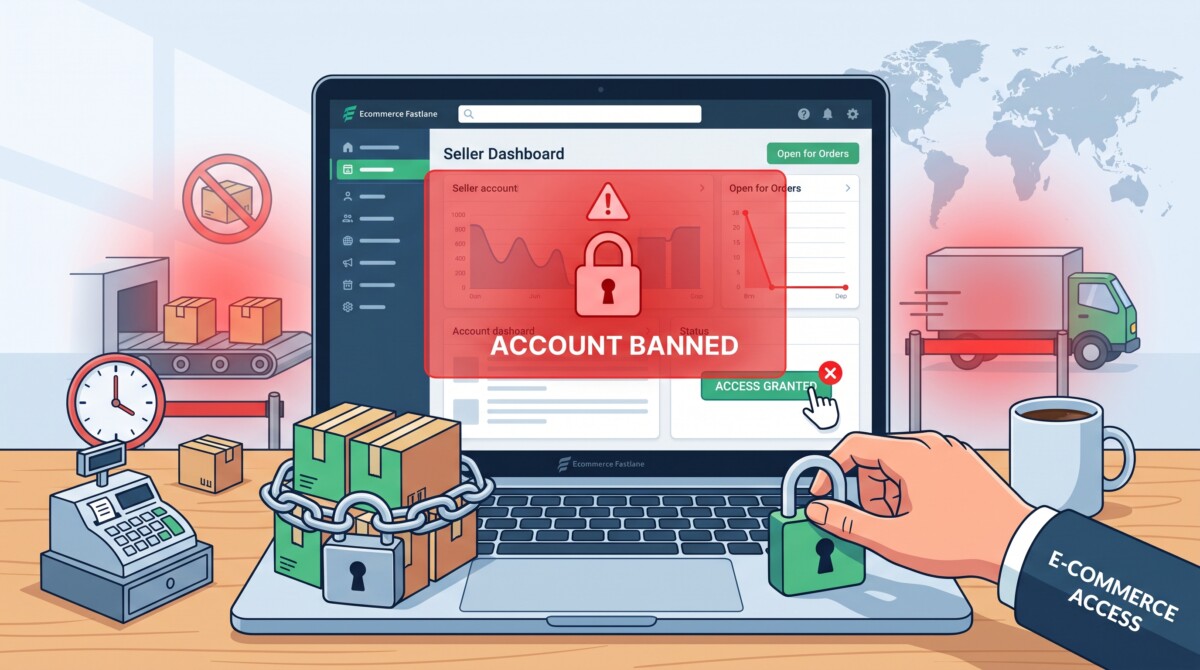
If your seller account is banned, you lose your listings, your ranking, your reviews and your access to buyers in the same hour, and funds can be held for up to 90 days. Starting on a platform is still usually right. Owning nothing that outlives the account is not.
Every platform hands you distribution you could not have built alone, and takes the customer relationship in exchange. That is a trade, and it is often the right one. The damage comes from never noticing you made it.
Open a marketplace seller account and the platform hands you something genuinely valuable on the first day: people who are already there, already logged in, already holding a payment method, already searching for what you sell. You did not have to build that. Almost nobody could.
In exchange, the platform holds the customer relationship, sets the price of access, and decides what you are allowed to sell and say. It can change all three without asking you. That is not a scam. It is a trade, and for most people starting out it is a sensible one.
The sellers who get hurt are not the ones who made the trade. They are the ones who made it, forgot they made it, and built four years of income on top of it. This piece is about what actually changed hands, what it looks like when the terms move, and what you can hold onto that survives an account you do not control.
Three specific things transfer to the platform when you open a seller account: the buyer relationship, the pricing power, and the editorial control over what you may offer. Everything painful that happens later traces back to one of those three, which is why it is worth naming them plainly before looking at the failure modes.
The buyer relationship means the platform, not you, holds the contact details and the permission to use them. The pricing power means the percentage the platform takes is set by the platform and revised on its own schedule. The editorial control means a category, a keyword, a material or an entire product line can become prohibited between one policy update and the next, and your listings go with it.
None of this is buried. Etsy’s current seller policy governing shop accounts took effect on July 9, 2026 and was last updated a month before that. It sets out, in ordinary language, that Etsy may limit the visibility of your shop, place reserves on your payments account, or suspend your account, and that it will generally notify you when it does, with exceptions. Most sellers agree to that at signup and never read it again.
Reading your own platform’s current version is a twenty minute job and it is the cheapest risk assessment available to you. If you are still deciding which platform to build on, or where you sit on the path from a first sale to a business you control, the four stages from side hustle to owned business map out where this decision usually lands for people at each point.
The platform owns the buyer relationship, and its policy says so in writing rather than by implication. Etsy’s seller policy states that without the buyer’s consent you may not add any Etsy member to your email or physical mailing list, or use that buyer’s identity for marketing. Amazon does not hand sellers buyer email addresses for marketing at all.
Sit with what that means at volume. A seller who has shipped 400 orders over two years has 400 people who liked their product enough to pay for it, and no way to reach any of them. Those are not customers in any sense a business owner would recognize. They are the platform’s customers, who happened to buy your thing.
Selling 400 units taught you that your product works. It did not build you an audience.
The rule is not arbitrary and it is not only about the platform’s commercial interest, though it serves that too. Consent based marketing is also what data protection law requires in most of the markets you are selling into, and Etsy makes sellers independently responsible for that compliance. A seller who scrapes buyer emails from order records is exposed on two fronts at once.
What you can do is ask. Every platform allows some version of an invitation to a list you control, whether that is a card in the box, a line in your shop policies, or a link in your profile. The conversion rate on those is low, often in the low single digits of buyers. Low is not zero, and low compounds. A shop doing 30 orders a month that converts 5% of buyers to a list adds around 18 contacts a year. Five years of that is a real asset that no policy update can take.
A platform can change what it takes from every future sale with a few weeks of notice, and the increase applies to the business you already built. On February 24, 2022, Etsy announced in a quarterly filing to the SEC that its seller transaction fee would rise from 5% to 6.5%, effective April 11. Forty six days of notice, and a 30% relative increase in the platform’s cut.
Look at what that does to a seller rather than to a spreadsheet. If you were running a 15% net margin on a $30 item, the transaction fee moving from $1.50 to $1.95 takes 45 cents from a $4.50 profit. That is 10% of your net income, removed by an announcement, with no change to your product, your work, or your customers. You either raise prices into a competitive category, absorb it, or shrink.
Marketplace transaction fees are also the smaller half of the story. Layered charges accumulate around the headline rate: listing fees, payment processing, offsite advertising fees on sellers past a revenue threshold, fulfilment charges, refund handling. A seller tracking only the headline percentage will consistently underestimate what the channel actually costs them, and will discover the gap in a year when volume is up and profit is not.
The practical response is to treat your rate card as a variable rather than a constant. Price with enough room that a two point move does not erase your margin, and know what your unit economics look like on the other platforms available to you before you need to know. Not so you leave. So that the decision is yours rather than the platform’s.
Funds you have already earned can be held for up to 90 days after an account is deactivated, which lands hardest on the sellers least able to absorb it. Amazon does not disburse to deactivated seller accounts during that window while claims, chargebacks and returns settle. Etsy’s policy permits reserves on your payments account and permits Etsy to recoup refunds from that reserve.
The cash flow damage is worse than the number suggests because of when it arrives. A seller who has bought inventory for a seasonal run has already spent the money. The stock is in the garage, the supplier has been paid, and the revenue that was going to cover it is frozen. A hold does not pause your obligations. It only pauses your income.
This is the specific failure mode that turns a recoverable account problem into a closed business. The account itself might come back in three weeks. The seller who had to put $4,000 of inventory on a credit card at 22% to bridge a 90 day hold is carrying that decision for a year afterward.
There is a boring defence and it is the right one at every stage: hold enough working capital outside the platform to cover 90 days of your fixed obligations. For a side hustle that might be a few hundred dollars. For a seller doing $20K a month it is a serious number, and if you cannot cover it, that gap is the most useful thing you have learned about your business this quarter. Concentration risk you cannot survive is a real constraint on how fast you should be growing, not a reason to grow faster.
You lose the storefront, the search ranking, the accumulated reviews and the buyer access simultaneously, and the appeal runs through an automated system that may never involve a human. Enforcement at platform scale is machine driven by necessity, and the error rate lands on individual sellers who have no way to escalate.
In June 2025, TechCrunch reported on a wave of Instagram account bans that users attributed to AI moderation, with appeals going unanswered and no route to a support person outside of paid verification. Four thousand people signed a petition. Meta declined to comment on the record. That October, CBC News documented a Canadian business owner who needed roughly a month to reach a human at Meta after his business accounts were wrongly suspended.
Notice the shape of that. Not a wrong decision that was appealed and reversed in 48 hours. A month of a business being unreachable while a queue moved. For a seller whose entire order flow arrives through that account, a month is not an inconvenience. It is a quarter of the year’s revenue.
Note also that notification is not guaranteed. Etsy’s seller policy commits to generally notifying sellers of a suspension, with stated exceptions for repeat violations and for legal or regulatory reasons that prevent it. Most enforcement comes with an email. Not all of it does, and the seller who assumes a warning always precedes an action is planning against the friendly version of the process.
The honest conclusion is that the appeal is not your safety net, because you do not control its timeline or its outcome. The only thing you control is what you still have on the day the appeal is pending.
Most platform dependency does not end in a ban, it ends in a slow decline in distribution that never announces itself. This is the version that affects far more sellers than deplatforming does, and it is the one people are worst at noticing, because nothing appears to have gone wrong on any individual day.
The data supports a grind rather than a cliff. Socialinsider’s analysis of 70 million social posts puts Instagram engagement at 0.45% in the first half of 2026, down from 0.52% a year earlier, with Facebook flat near 0.15%. That is not a channel being switched off. It is a channel returning a little less each quarter while you work the same amount.
Marketplace visibility behaves the same way, and occasionally in ways that feel backwards. Etsy’s own policy notes that a rapid increase in orders can sometimes reduce a shop’s visibility rather than raise it. A seller who has a good month and then a strange quiet one has not necessarily done anything wrong. They may simply have moved through a ranking system whose rules they were never shown.
I want to be careful not to oversell this, because the panic version of this argument is everywhere and it is not accurate. Reach did not collapse overnight and your account is probably not shadowbanned. What is true is more mundane and more expensive: the cost of reaching the same number of people through a channel you do not own goes up over time, and the only defence is a channel where reaching your people costs the same next year as it did this year.
Starting on a marketplace is the correct move for most new sellers because it removes the hardest problem from your first year, which is not making the product but finding anyone who wants it. Advice that tells a beginner to skip the platform and build direct is usually advice from someone who has forgotten how hard a cold start is.
Consider what you are actually being asked to solve on day one without a platform. Product, pricing, fulfilment, customer service, payment infrastructure, and demand generation, all simultaneously, with no signal about whether anyone wants the thing. A marketplace hands you the last one and lets you learn the others against real orders. That is not a shortcut, it is a legitimate sequencing decision.
The behaviour of successful small sellers supports this. In a survey of US ecommerce side hustlers reported by Forbes, half were using online marketplaces such as Amazon as a critical channel, 57% relied on owned social accounts for traffic, and about a third used email marketing. A third of them launched with between $500 and $1,000. These are not people who built an audience first. They started where the buyers already were, and the strong ones added owned channels alongside.
So the argument here is not that renting distribution is a mistake. It is that renting is a stage, not a destination. The mistake I have watched play out repeatedly is the seller who treats a working platform channel as a finished business and stops building, then discovers at $200K a year that they have revenue, no customer list, and nothing that transfers. If you are at the very beginning of this, the practical first steps for an ecommerce side hustle still start on a platform, and should.
Three moves reduce platform concentration without asking you to leave the channel that pays you: build a contact list you own, add a genuinely different second channel, and know in advance which of your assets travel. None of them require you to abandon anything.
The contact list is first because it is the only one that is purely additive. An email list costs almost nothing at small scale, transfers between providers, and gives you a way to tell people where you went. Start asking on day one rather than at $100K, because the asset is built from orders you have already shipped and you cannot go back for them later. If you want the tactical version, there are nine practical ways to build a list from scratch that work at any volume.
The second channel matters less than people think and matters in a specific way: it must fail for different reasons than the first. Two marketplaces with similar enforcement models and similar policy sensitivities are one channel wearing two hats. A marketplace plus your own storefront is genuine diversification, because a suspension on one has no mechanical connection to the other. Brands that operate where paid channels can be cut off entirely tend to build this discipline early, and the way they construct an owned media system under those constraints is instructive even if your category is unrestricted.
Then know what travels. Your product knowledge, your supplier relationships, your photography, your brand name, your email list and your domain all move with you. Your ranking, your reviews, your follower count and your listing history do not. That division is worth writing down once, because it tells you exactly where to invest your next hour of effort. When most of the value you have created sits in the column that does not travel, you have a concentration problem regardless of how well the month is going. The rent versus own channel test works through the same question for operators running multiple channels at scale.
Your listings are removed from search, your shop stops taking orders, and your access to buyer communication is cut, usually within the same hour. Funds already earned can be held while claims and returns settle, and Amazon does not disburse to deactivated seller accounts for 90 days from deactivation. You can appeal, but appeals are largely automated and timelines range from days to months with no guaranteed outcome. Your reviews, ranking and follower count do not transfer anywhere. What survives is whatever you built outside the account: your email list, your domain, your supplier relationships and your product knowledge.
Up to 90 days is the common ceiling on major marketplaces, and the clock typically starts at deactivation rather than at the moment you appeal. Amazon holds disbursements on deactivated accounts for that period while chargebacks, A to Z claims and returns resolve. Etsy’s seller policy permits reserves on your payment account and permits Etsy to recoup buyer refunds from that reserve. A successful appeal does not always release funds immediately. The practical implication is that you should hold roughly 90 days of fixed obligations in working capital outside the platform, because a hold pauses your income without pausing what you owe suppliers.
No. Etsy’s seller policy states that without a buyer’s consent you may not add an Etsy member to your mailing list or use their identity for marketing, and buyer information you receive through a transaction may only be used for Etsy related communication. Amazon does not provide buyer email addresses for marketing purposes at all. Both restrictions align with data protection law in most markets, and platforms make sellers independently responsible for that compliance. What you can do is invite buyers to opt in through a packaging insert, your shop policies, or a profile link. Opt in rates are usually low single digits, which still compounds meaningfully over years.
Start on a marketplace if you do not yet know whether people want your product, because the marketplace solves demand generation, which is the hardest problem in your first year. Building your own storefront first means solving product, fulfilment, payments and traffic simultaneously with no signal about demand. The sequencing that works for most sellers is to validate on a platform, then add an owned storefront once you have proof of demand and repeat buyers. The error is not starting on a marketplace. The error is treating the marketplace as the finished business and never building anything that survives the account.
Two channels that fail for different reasons beats three that fail for the same reason. Two marketplaces with similar automated enforcement and similar policy triggers behave as one channel during a problem, because whatever flags you on one often flags you on the other. A marketplace plus a storefront you control is genuine diversification. Adding channels also adds real operational cost, so a seller under roughly $50K a year is usually better served by one strong platform plus an email list than by three thinly managed storefronts. The count matters less than whether the failure modes are independent.




