Free every Thursday · 59,694 Readers
Fastlane Insider Newsletter: What's working for Shopify in the AI era?
Free every Thursday · 59,694 Readers
Fastlane Insider Newsletter: What's working for Shopify in the AI era?
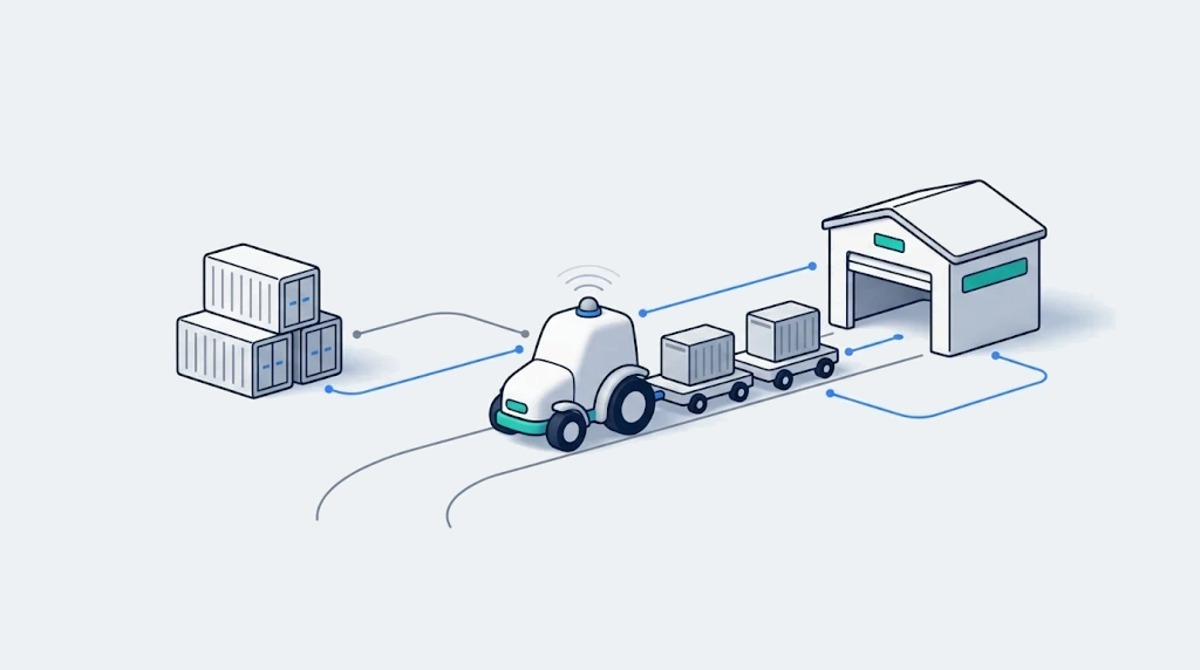
The hard part of a driverless cargo tractor is rarely the driving. It is the hitch, the handoff and the hundred small exceptions a human driver handled without anyone ever writing them down.
Autonomous vehicles are no longer limited to experimental projects or public road trials. In industrial logistics, they are already moving containers, towing baggage and cargo dollies, and carrying materials across ports, airports and manufacturing sites. Behind those capabilities, artificial intelligence does the work of helping each vehicle understand its surroundings and respond when conditions change.
Conventional vehicle automation follows predefined instructions. AI-powered autonomous vehicles can process information about their environment, recognize operational risks, and make decisions based on what is happening in real time. That difference matters most in industrial settings, where vehicles share space with workers, heavy equipment and other transport systems.
It also matters further down the supply chain than most people look. The container of finished goods a Shopify brand imports, and the air freight carrying its cross border orders, pass through exactly these terminals. For a business considering autonomous logistics, the value does not come from making a vehicle driverless. It comes from safer movement, more reliable task execution and better coordination across daily operations.
Artificial intelligence works in autonomous vehicles by turning sensor data into three decisions in sequence: what is around the vehicle, what those objects are likely to do next, and how the vehicle should move to finish its task safely. Instead of relying only on fixed routes or programmed instructions, an AI system interprets changing conditions and chooses a response.
Most industrial vehicles in this category are built to what the SAE J3016 levels of driving automation call Level 4: the system performs the whole driving task and handles its own fallback, but only inside a defined operating area and set of conditions. A terminal, an apron or a factory yard is a natural fit for that definition, because the area can be mapped and its rules written down.
An autonomous vehicle has to identify what is happening around it before it can make any driving decision. Sensors collect the raw information, and AI algorithms interpret it. A vehicle working in a container terminal, for example, needs to recognize other vehicles, stacked containers, workers on foot and temporary obstacles, then build a working picture of the space around it.
Sensor fusion strengthens that picture by combining several sources instead of depending on one. When glare, rain or darkness weakens one sensor, the others fill the gap. The same computer vision techniques that retailers use for shelf monitoring sit at the core of this layer, applied to a far less forgiving environment where industrial sites are rarely predictable from one hour to the next.
Recognizing an obstacle is only part of the job; the vehicle also has to judge how surrounding objects will move and whether its route is still safe. AI based prediction estimates the likely paths of nearby people, vehicles and equipment, and the system adjusts speed, direction or route before a conflict develops.
Consider a terminal where autonomous tractors and manually driven trucks share some lanes. A system that only knows where a truck is right now has very little time to react when it turns. A system that predicts where the truck is heading can slow early and keep traffic flowing. That is why prediction matters most in mixed traffic with complex operating rules.
Once the vehicle understands its environment and the likely movements around it, navigation and motion control turn that understanding into precise movement. That can mean following a planned route, steering around an obstacle, adjusting around other equipment, or positioning accurately at a loading or towing point. In industrial work, the last few centimeters often matter most: approaching a trailer, aligning with a transfer area, or maneuvering through a narrow lane between stacks.
AI powered autonomous vehicles are used today mainly for short, repetitive transfers at container terminals, airport cargo and baggage areas, and factories or logistics parks, and each setting asks for a different configuration. The transport task, the traffic mix and the site layout decide what the vehicle has to be good at.
Ports move large volumes of containers between quay cranes, storage yards and gate areas, often through the same short trip repeated thousands of times. Autonomous vehicles can support that work by reading their surroundings, following planned routes and reacting to changing traffic. Connected to an intelligent scheduling system, a fleet can also receive tasks and coordinate movements across the yard, which is where much of the value sits.
Port environments are demanding. Vehicles operate around cranes, containers, workers and manually driven equipment, so reliable perception, predictive decision making and communication with the terminal’s operating systems are all essential. For a brand importing by sea, terminal dwell time is one of the less visible lines in its lead time, and Fastlane’s guide to international ecommerce logistics in 2026 covers how that lead time feeds into landed cost and carrier choices.
Airports depend on moving baggage, cargo and ground service equipment on time, and a delay at one stage spreads to the next. Online orders are a large share of that cargo: Andre Majeres, IATA’s Head of E-Commerce and Cargo Operations, said that about 20 percent of air cargo now comes from an ecommerce transaction.
Autonomous tractors can take on repetitive towing between fixed airport locations. Perception lets them recognize surrounding equipment and ground crews, while navigation handles route execution and precise positioning at dollies and loading points. Airside conditions change constantly with aircraft movements and crew activity, so autonomous systems have to work inside established safety procedures and coordinate with the airport’s wider ground transport process rather than around it.
Manufacturing sites and logistics parks constantly move raw materials, components and finished goods between work areas. Autonomous vehicles can take over those recurring trips by following assigned routes, identifying obstacles and adjusting when conditions change. The bigger gain comes when the vehicles connect to production schedules and logistics systems, so material arrives when the line needs it rather than when a driver is free. That is the outdoor, between buildings counterpart to the warehouse automation that robotic storage brings inside the building.
The right setup depends on facility layout, traffic density, cargo type and how much automation already exists. A solution built for outdoor industrial transport may need a very different configuration from one running inside a production hall.
AI powered autonomous vehicles differ from traditional automation because they interpret their environment and make decisions when conditions change, while traditional systems perform specific tasks under conditions set in advance. The table compares the two across six areas.
The distinction does not mean every AI powered vehicle can handle every situation on its own. Its capabilities still depend on system design, operating conditions, safety requirements and the level of autonomy it supports. For an industrial buyer, the more useful question is narrower: can this technology perform the transport tasks my facility actually runs, with consistent and controllable results?
Businesses should evaluate how an autonomous vehicle performs inside their own transport environment, across perception, positioning, prediction, safety, fleet coordination, integration and support, because AI capability on a spec sheet does not guarantee a successful deployment. These seven questions give a pilot its scope.
A practical starting point is one transport process with recurring tasks and clearly defined operating rules. Evaluate vehicle performance, safety, task completion and system compatibility there before expanding. Then look at the whole operating model, because a vehicle that performs well in a test can still struggle once it meets other equipment, existing traffic rules and daily schedules.
The public record at Hong Kong Air Cargo Terminals (Hactl) shows what that narrow start looks like. Westwell and Hactl first agreed to work together on an autonomous tractor for towing cargo dollies, and Airports International reported that the stated goal was vehicles that couple and uncouple the dollies automatically. The task was one repeated move inside one terminal, and the problem named in public was the hitch, not the driving. In 2025, according to Self Driving Cars 360, Westwell received approval to deploy its autonomous electric tractors at Hactl. The lesson for any buyer is to put the handoff steps (coupling, loading, the stop at the transfer point) in the pilot’s acceptance test, measure them on your own trailers or dollies, and leave fleet wide scheduling and a second route out of the first phase until that one route runs cleanly.
Automation results often fall short because the hardest problems in a terminal are exceptions, data quality and process design rather than the machines, so a business case built on the vehicle’s capability alone tends to overpromise. The best documented example comes from container ports.
In its report on the future of automated ports, McKinsey surveyed port operators, equipment suppliers and other industry leaders in 2017. Respondents expected automation to cut operating expenses by 25 to 55 percent and raise productivity by 10 to 35 percent. The survey found operating expenses at automated ports fell by only 15 to 35 percent, and productivity actually fell by 7 to 15 percent. The report pointed to poor data quality, siloed operations and exception handling as the main reasons, and noted that many ports automated old processes instead of simplifying them first.
That finding is from a 2017 survey, and AI perception and prediction have improved a great deal since then, so it is not a verdict on today’s vehicles. It is still the right benchmark for a business case. A buyer who budgets for the vehicles and not for process redesign, data cleanup and exception handling is setting up the same gap. The practical response matches the evaluation advice above: simplify the process first, automate one recurring task, define the exceptions and who handles them, and set productivity and cost targets before the first vehicle arrives.
Westwell applies AI in autonomous vehicles through an autonomous driving platform built into electric commercial vehicles for ports, airports and logistics facilities, with a focus on fitting those vehicles into the site’s wider operating system. Westwell develops AI-powered transportation solutions for these industrial environments, and its Qomolo product portfolio combines autonomous driving with new energy commercial vehicles for different transport needs.
At the technology level, the company describes its WellDrive platform as bringing three capabilities together. High precision positioning uses multi source fusion to keep accurate location information in complex environments, including areas with signal obstruction and difficult weather. Omni domain fusion perception uses configurable multi-sensor fusion to identify operational targets under changing lighting, weather and site conditions, and lets vehicles share perception data across the fleet. Intelligent prediction draws on experience from real industrial scenarios to predict the paths of people, vehicles and equipment in mixed traffic, supporting better decisions when conditions are not fully predictable.
Those capabilities show up in two vehicles. Q-Truck is a cabless autonomous heavy duty vehicle designed for container transport in ports. Q-Tractor is an autonomous electric tractor built for high frequency towing at air cargo terminals and industrial parks; Westwell lists 360 degree perception and L4 autonomous driving among its capabilities. Beyond Hactl, Westwell’s technology has been deployed at Hong Kong International Airport, Shanghai Pudong International Airport and Ezhou Huahu International Airport, as reported by Self Driving Cars 360.
By combining vehicle intelligence with operational coordination, Westwell addresses a broader challenge in industrial logistics: making sure autonomous vehicles perform their tasks as part of an organized operating system, rather than as isolated driverless machines.
For most ecommerce brands, AI autonomous vehicles are something to understand rather than something to buy, because they run inside ports, cargo terminals and large warehouses that your freight forwarder and 3PL choose for you. The effect reaches you through lead times and reliability at those hubs, not through a purchase decision of your own.
If you are Growing and ship parcels from a stockroom or a single 3PL, nothing here changes your plan; your fulfillment decisions are covered in Fastlane’s guide to choosing between in-house fulfillment and a 3PL. If you are Scaling and importing full containers, ask your forwarder which terminals handle your freight and how their dwell times have moved over the past year, then plan reorder points around the real number. If you are Leading and run your own distribution center or yard, the evaluation checklist above applies to you directly, starting with one recurring move such as trailer shuttles between a dock and a cross dock area.
The future of artificial intelligence in autonomous vehicles points toward fleets that coordinate with each other and with the systems around them, rather than single vehicles that detect obstacles and follow routes. The development of AI in autonomous vehicles is moving past basic obstacle detection, as advances in perception, behavioral prediction, decision making and intelligent scheduling expand what these systems can support in industrial settings.
As those capabilities mature, the link between individual vehicles and wider logistics operations becomes the main event. Vehicles will need to coordinate with other vehicles, equipment and management systems to support more complex transport processes. The same shift is under way at the other end of the chain, where Fastlane’s look at the delivery race and last mile autonomous vehicles describes autonomous ground vehicles moving from pilots toward commercial service.
For industrial businesses, adoption will likely stay application specific. Ports may prioritize container transport and fleet coordination, airports may focus on baggage and cargo towing, and factories may put the most weight on internal material movement. In every case, the value of AI in autonomous vehicles should be judged by how well it supports real operating requirements: reliable perception, safe decisions, accurate positioning and coordinated transport are what turn the technology into practical industrial value.
Machine learning lets autonomous driving systems learn patterns from data so they can recognize objects, predict behavior and choose actions in situations a fixed rule set would not cover. In practice it powers the perception layer, which identifies vehicles, people and obstacles from sensor data, and the prediction layer, which estimates how those objects will move next. In industrial environments, training on real operating scenarios helps a system understand how vehicles, workers and equipment interact at a specific kind of site, such as a container yard or a cargo apron. Machine learning does not remove the need for defined operating areas, safety rules and human oversight of exceptions.
AI is used in industrial autonomous vehicles for environmental perception, positioning, route planning, obstacle handling and fleet coordination. Perception and positioning tell the vehicle what is around it and exactly where it is, prediction estimates how nearby traffic will move, and navigation turns those inputs into precise movement. Common applications include moving containers between cranes and yards at ports, towing baggage and cargo dollies at airports, and carrying materials between work areas in factories and logistics parks. The biggest gains usually come when the vehicles connect to scheduling and logistics systems, so each move is assigned and timed as part of the wider operation.
The difference is that AI powered autonomous vehicles use artificial intelligence to perceive, predict and decide, while traditional automated vehicles depend more heavily on predefined routes and fixed operating rules. A traditional system performs well when conditions match what it was configured for. An AI powered system can interpret changing conditions, such as an unexpected obstacle or a manually driven truck changing lanes, and adjust its behavior. In practice the line is not always sharp: the real distinction depends on which technologies and autonomy capabilities each vehicle actually implements, so buyers should ask vendors to demonstrate behavior on their own site rather than rely on labels.
Yes, some AI autonomous vehicles are designed for complex industrial environments, using multi-sensor fusion, high precision positioning and behavioral prediction to work around people, equipment and other vehicles. They typically operate at SAE Level 4, which means they drive themselves fully but only inside a defined area and set of conditions. Deployment still requires suitable site conditions, clear safety management and integration with existing operations. Experience from automated ports shows that exceptions, data quality and process design decide results as much as the vehicle does, so a first deployment should start with one recurring task and expand once that task runs reliably.
Autonomous port and airport vehicles can affect ecommerce shipping times indirectly, through how quickly and reliably terminals move containers and cargo, but they are one factor among many. Terminal dwell time, customs clearance, carrier capacity and inland transport all shape the lead time a brand sees. Online orders are a large share of air cargo, with IATA’s Andre Majeres saying about 20 percent of air cargo comes from an ecommerce transaction, so cargo hub efficiency matters to cross border sellers. For most brands the practical step is to ask a freight forwarder which terminals handle their freight and plan reorder points around actual dwell times.