A 3PL can solve your capacity problem within weeks of signing. It cannot solve your data problem, and the data problem is what shows up first.
Ben Hussey is co-CEO of Katana, a cloud inventory platform that says it runs inventory and production for more than 1,500 product businesses, so he sees the orders those brands place with their suppliers every month. When I had him on episode 484 of the podcast, the conversation kept circling one idea: selling on more than one channel is easy, and having those channels actually connected is the hard part. I opened that episode by joking that “there’s a lot of duct tape going on for a lot of brands and a lot of different team members come and go.” That duct tape is where most fulfillment decisions go wrong.
Now, a fulfillment question I hear a lot from merchants sounds like a vendor question: should I use a 3PL, and which one? I’d argue it is really a sequencing question. When do you stop packing orders yourself, what has to be true about your inventory data before you hand it to someone else, and what goes wrong in the first three months after you do? This guide answers those three questions for each of the four stages Fastlane uses across its pillars: Starting (pre-launch to $10K a month), Growing ($10K to $100K a month), Scaling ($100K to $1M a month) and Leading ($1M or more a month).
For a store still weighing its first move, the choice between in-house fulfillment and a 3PL depends as much on whose hours the work consumes and whether one system owns the inventory count as on the pick and pack fee, because that fee is one of the smaller lines on the invoice. Most founders start the comparison by lining up pick and pack quotes. I’d argue that is the wrong place to start.
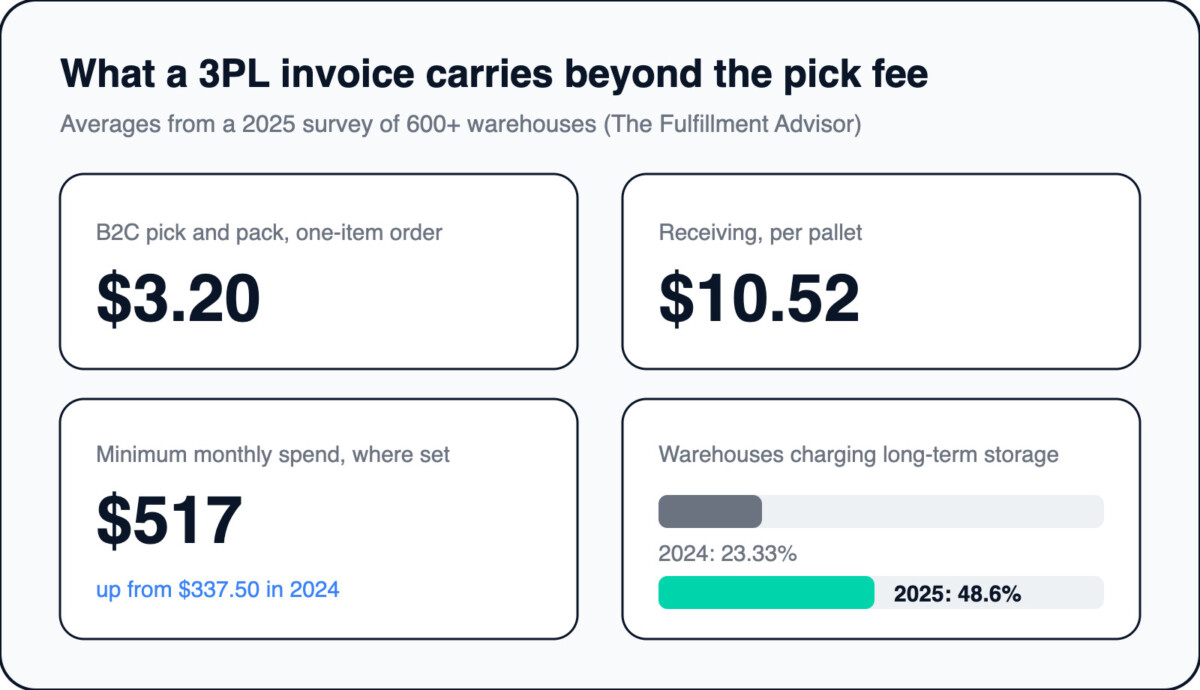
Here is an illustrative example, comparing like with like. Assume 1,000 single-item orders a month and about six minutes to pick, pack and label each one. That is roughly 100 hours a month, or about 23 hours a week. At an assumed $22 an hour loaded cost for a packer, pick and pack labor comes to about $2,200 a month, or $2.20 an order. The 2025 survey of more than 600 warehouses by The Fulfillment Advisor (formerly Warehousing and Fulfillment) put the average B2C pick and pack fee for a one-item order at $3.20. In this scenario the gap is about a dollar an order, and receiving, storage, packaging, returns and shipping sit outside both numbers.
Those other lines are where the decision usually moves. First, whose 23 hours those are: if they are the founder’s, the real cost is the growth work that is not happening. If they belong to a paid team, the comparison becomes a fully loaded cost exercise. Second, the carrier label, typically a bigger number per order than the pick fee, and where a 3PL’s negotiated rates and warehouse locations can change the math in either direction. Third, capacity at peak, when an in-house team that handles 30 orders a day comfortably meets a 300 order day. Run the comparison on your own order mix and real quotes; this example only shows which lines to compare.
The fourth factor is the one this guide keeps coming back to: data. A 3PL ships whatever your systems tell it exists. If Shopify, your marketplace listings and your stockroom disagree about how many units you have, a 3PL will ship the disagreement faster. Fixing that before the move is cheaper than fixing it after.
The cash side of this decision, including how inventory and fulfillment costs flow through contribution margin, belongs to the ecommerce accounting guide for Shopify stores. This piece stays on the operational call.
A Starting store under $10K a month should usually pack and ship its own orders and write down exactly how it does it, because at that volume a 3PL’s minimums and setup work tend to cost more than the hours they save, and that written process is what a future hire or warehouse will need. Illustratively, at a $60 average order, $10K a month is about 165 orders, or five or six a day. That is an evening’s work, not a job.
The 3PL math rarely works here yet. The same 2025 Fulfillment Advisor survey reported an average minimum monthly spend of $517 among warehouses that set one, up from $337.50 the year before, and the publisher’s 2026 update lists a higher average of $752.08. Not every warehouse sets a minimum, so get quotes if you have no space or ship bulky goods, but a store shipping 100 orders a month to a warehouse with a minimum would be paying far more than its pick fees. Buy good boxes, use Shopify Shipping discounted labels, and keep the setup simple.
If your stock lives at home, check the boring thing first. A standard homeowners policy covers very little business property, and Fastlane’s guide to home-based ecommerce fulfillment insurance walks through when an endorsement is enough and when you need an in-home business policy.
The most valuable thing you can do at this stage costs nothing: write down how you fulfill an order. Which box for which product, what goes in the box, how you handle a gift note, what you do when an item is damaged, how you process a return. I sold on eBay from 2001 to 2008, long before I worked at Shopify, and the stuff that lived only in my head was always the stuff that broke when someone else tried to help. That written process becomes the standard operating procedure you hand a hire or a 3PL later, and it is the single document most brands wish they had on the day they switch.
One more habit worth starting now: keep Shopify as the only place you change inventory counts. If you also sell on Etsy or at markets, connect those channels to Shopify through an app that syncs stock, update Shopify first, and confirm the change reached the other channel. Fastlane’s breakdown of shipping every channel from one place covers the tools that help a self-shipping store keep one order queue across channels.
A Growing store between $10K and $100K a month should move fulfillment off the founder once picking and packing passes roughly 15 hours a week, and the choice between a first hire and a 3PL depends on whether you want to own the process or rent the capacity. The 15 hour line is the checkpoint I use in the operations chapter of my book in progress, Thriving with Shopify, where it triggers the first operations or fulfillment hire, usually somewhere between $30K and $50K a month. Treat it as the point to price both options, not as an automatic switch. A store with no storage space or customers far from the founder may reasonably outsource sooner.
Aras Kolya, Chief Revenue Officer at ShipMonk, described why founders miss that line when I spoke with him on episode 410. He said “the first warning signs are almost invisible,” and that the first one is that “you’re solving fulfillment problems with your leadership’s time.” The second, in his telling, shows up later on the balance sheet as shipping costs climb and stock sits idle, and the third is customers getting late or broken packages. By the time the third sign appears, the first two have often been running for a while.
Choose in-house fulfillment with a hired packer if you are a Growing store with complex, fragile or customized products, a space that can hold a packing station, and a founder who wants control of the unboxing; at the low end of this band, a part-time hire working from your written SOP can cost less than a 3PL with a monthly minimum, so price both.
Choose a 3PL if you are a Growing store with standard products that ship in a few box sizes, peaks that would overwhelm a one-person team, or customers far enough from you that delivery times are costing sales; the 3PL rents you capacity and carrier rates you cannot get alone.
Either way, the move is a project, not a switch. My 2025 conversation with Shopify’s Vibhor Chhabra on Shopify Shipping and 3PL matching covers the thinking behind what Shopify itself offers here. Inside the admin, Shopify’s Fulfillment Network app connects merchants with 3PL partners, including Flexport, as of November 2026, and most independent 3PLs connect through their own Shopify apps. Shopify treats an app that stocks inventory for you as a location, and as of November 2026 those app locations do not count toward your plan’s location limit, according to Shopify’s help page on setting up locations.
If you are reading this in November, one timing call: do not cut over to a new 3PL in the weeks before Black Friday. Run the season on what you have, document everything that went wrong, and move in January or February when volume is lower and the 3PL has time to onboard you properly.
A Scaling store between $100K and $1M a month should add a second fulfillment location only after one system owns the inventory count across every channel and location, because a second warehouse doubles the places your count can be wrong. This is where Ben Hussey’s point from episode 484 matters most. “You need a single source of truth that understands the full picture of what I have in stock and where it is,” he said, so that the business never sells more than it can ship or sits on stock it could have sold [07:48].
Paolo Vidali, Founder and CEO of Hidden Gears, put the same idea as a question every brand with a warehouse integration should be able to answer. On episode 413, he asked: “does a warehouse own the inventory count or does Shopify own the inventory count?” Then he added a second question: “is that written down anywhere?” The point is that someone can look it up on a Friday night during Black Friday when something breaks. In his experience, warehouse integrations that sync too slowly are how brands end up overselling to hundreds of customers at once, which is why the sync itself has to run continuously; a daily reconciliation is the audit that catches what the sync missed, not a replacement for it.
Once that question has a written answer, a second node can pay off. James Solier, Senior Vice President of Central Operations at ShipBob, explained on episode 438 why a merchant around $500K a month might split inventory across regions: placing stock closer to customers shortens transit times, and in his words “shorter promises convert more.” It also opens up regional carriers in larger cities. The trade is more inventory in total, because each node needs its own safety stock.
Choose a multi-location 3PL setup if you are a Scaling store with demand concentrated on two coasts or in two countries, an inventory system that already syncs every channel continuously and reconciles cleanly, and enough SKU depth that splitting stock does not leave either node short. Staying with one warehouse and one provider is also a legitimate answer at this stage if delivery times are not costing you sales.
On Shopify, plan limits matter here. As of November 2026, Shopify’s help center lists two active locations on Starter, ten on Basic, Grow and Advanced, and 200 on Plus. When native routing stops being enough, Fastlane’s comparison of Shopify order management systems shows where an OMS starts to earn its cost.
Forecasting and replenishment tools sit next to this decision and get their own coverage in the AI Operations section of the site. One date matters now: Shopify retired Stocky on August 31, 2026, and its migration guide moves transfers, purchase orders and stock counts into the Shopify admin. If a 3PL move and a Stocky migration land in the same quarter, do the inventory migration first.
A Leading store above $1M a month often ends up with a hybrid fulfillment model, where different product lines or channels ship from different places, and brings work back in-house only when a full operating-cost comparison, not just the 3PL invoice, favors owned space and staff. Hybrid is common, not mandatory: one provider and one warehouse can still be the right answer. Ben Hussey described the same pattern from Katana’s customer base: “What we see more and more, particularly with kind of the more in the medium sized businesses, is the hybrid business model” [18:44]. His example was a brand that makes its original product line and ships it from its own warehouse, while a newer line is co-manufactured and shipped from a 3PL, sometimes with the core products sent to the 3PL as well.
He was blunt about what that does to stock control. With raw materials, kits and finished goods spread across locations, he said, “even at five SKUs, your head’s going to start to hurt” [20:22]. A spreadsheet will not hold that together at a thousand orders a month. That is the honest case for an inventory system at this stage, whether it is Katana for brands that manufacture their own products or another platform for brands that only resell finished goods.
Choose a hybrid network if you are a Leading store with product lines that need different handling (made to order, oversized, regulated, subscription), wholesale or retail channels alongside DTC, and an inventory system that already owns the count across every location.
Choose to bring fulfillment back in-house if you are a Leading store whose total 3PL cost, including storage, minimums and surcharges, now exceeds the full cost of owned space, staff, equipment, systems, insurance and the transition itself, and you have an operations lead who can run a warehouse. Fastlane’s guide to leasing warehouse space after your 3PL covers what to check before signing a lease, and the reliability side, from power to drainage, is in why facility reliability is the backbone of ecommerce growth.
One forward-looking note at this stage. Ben’s episode also covered AI agents reading live inventory through MCP connections. Whether an assistant can see accurate stock depends on the same single source of truth this guide keeps asking for. The strategy behind that shift lives in Fastlane’s agentic commerce guide for Shopify, and the operational lesson is simple: an agent can only sell what your systems correctly say you have.
The three things most likely to break in the first 90 days after moving to a 3PL are the inventory count, the instructions nobody wrote down, and the first full invoice and peak, and each one has a cheap check that catches it early. Those are the failure points my podcast guests describe most often; the month-by-month order below is one illustrative way they can land. The walkthrough is a composite, built from those patterns, not a single real brand, and its numbers are illustrative.
Picture a Growing skincare brand at about $70K a month, shipping around 1,100 orders a month at a $63 average order, moving from a garage packing station to its first 3PL in late January.
Days 1 to 30: the count. The brand ships 41 cartons to the warehouse. Shopify says 4,800 units. The warehouse receives 4,710, because a few cartons held a mix of SKUs the packing list did not show and two bundle SKUs were never set up as kits. For the week receiving takes, the stock is in transit but not sellable, and the storefront either oversells or shows items as sold out. The fix is unglamorous: count before you ship, label every carton with a single SKU, set up bundles as kits in both systems, and decide in writing which system owns the count. Fastlane’s piece on why fulfillment delays start on the receiving dock explains the dock-to-available time to ask your 3PL for.
Days 31 to 60: the instructions. Orders go out on time, but the thank-you card stops appearing, gift notes print on the packing slip with prices showing, and returns pile up in a corner of the warehouse unprocessed. Kyle Bertin, Co-Founder and CEO of Two Boxes, which builds returns processing software used mostly by 3PLs, was direct about this on episode 436: “If you don’t have a documented SOP with your 3PL, they will not follow it. And even if you do, they probably still won’t follow it 100% to the letter of the law all the time.” His advice was to go into the facility and watch what your instructions actually make people do. He also noted that 3PLs are built around getting orders out, so returns get less attention by default. For the money that leaks out of slow returns, see Fastlane’s guide on turning ecommerce returns into profit.
Days 61 to 90: the invoice and the first peak. The first full monthly invoice arrives and it is well above the pick fee times order count. Receiving, storage, packaging, a monthly minimum in the slow month, and a long-term storage charge on slow sellers that sat untouched. That last line is no longer unusual: the 2025 Fulfillment Advisor survey found 48.6% of warehouses charging long-term storage fees, up from 23.33% a year earlier. Then a creator post drives a 600 order weekend, and the founder spends Sunday answering “where is my order” emails, which is exactly Aras Kolya’s invisible first warning sign showing up again.
The checks that would have caught each one are simple. Before cutover: a counted inventory file, kits mapped, the count owner written down, a one-page SOP with photos. In the first 30 days: confirm the inventory sync runs and alerts on failures, audit Shopify against the 3PL’s counts weekly on top of it, and visit the warehouse once. Before the first invoice: ask for a fully loaded cost per order on your real order mix. ShipBob’s pricing team makes the same case in their piece on what is actually in your cost per order, which is worth reading even though it comes from a 3PL.
The first 3PL contract should cover one warehouse, your current channels and your current packaging, because every add-on signed in the first 90 days becomes another place for the count, the instructions or the invoice to break. My view, from my years at Shopify and from the merchants and agency partners I talk with, is that the $500K to $2M stage stalls more often from premature complexity than from missing tools. Fulfillment is where that shows up as physical boxes in the wrong building.
So here is what I would leave out by default, even when the 3PL offers it on the first call, along with the exceptions that override it. A second node: wait until one warehouse has run clean for a full quarter, unless delivery promises to a major market already require one. A new sales channel launched in the same quarter as the move: if you are adding Amazon or TikTok Shop, do it before the switch or after the first 90 days, not during. A separate WMS or OMS purchase: a 3PL runs its own warehouse system, and most stores do not need an order management layer until they have more than one location or channel routing rules that Shopify’s native routing cannot handle. A packaging redesign: hold it until order accuracy meets the target you agreed with the 3PL in writing, unless the product needs protective packaging to arrive intact.
That list includes things sold by companies Fastlane works with, including 3PLs whose people have been on the show. That is the point. The right first move is often less than the sales deck suggests, and a 3PL worth working with will tell you the same.
If you are Starting, none of this applies yet: keep packing, keep writing down how. If you are Growing, run the 15 hour test this week and price both a hire and a 3PL on your real order mix. If you are Scaling, answer Paolo Vidali’s question in writing before you add a building. If you are Leading, audit which work belongs in which location before you renew anything.
Disclosure: Fastlane Media is a Shopify Partner and earns commission from Shopify referrals. Fastlane also earns commission on ShipBob referrals through Impact. Some names on this page, including Shopify, Katana, ShipBob, Two Boxes, Amazon and TikTok, are linked automatically through Fastlane’s /recommends/ links, which can earn a commission. Katana, ShipMonk, ShipBob, Two Boxes and Hidden Gears each appeared on paid episodes of the eCommerce Fastlane podcast quoted or linked here. None of them paid for, reviewed or approved this article. Shopify plan limits and the Stocky date were checked on Shopify’s help center in November 2026; 3PL fee figures are survey averages and will differ from your quote.
A Shopify store should price a 3PL against a first hire once picking and packing takes the founder about 15 hours a week, often somewhere between $30K and $50K a month in revenue. At that point the hours are coming out of growth work. Before switching, compare a 3PL against hiring a part-time packer, because at the low end of that range a hire can cost less than a 3PL with a monthly minimum. A 3PL wins when products ship in a few standard boxes, peaks would overwhelm one person, or customers are far enough away that delivery times cost sales. Avoid cutting over in the weeks before Black Friday; move in a quieter month instead.
A 3PL charged an average of $3.20 to pick and pack a single-item B2C order in the 2025 survey of more than 600 warehouses by The Fulfillment Advisor, but that fee is only one line on the invoice. The same 2025 survey reported average receiving fees of $10.52 per pallet and an average minimum monthly spend of $517 among warehouses that set one; the publisher’s 2026 update lists a higher average minimum of $752.08. Add packaging, storage, long-term storage surcharges on slow sellers and, largest of all, carrier labels. Ask every 3PL for a fully loaded cost per order using your real order mix and SKU sizes before you compare quotes, because headline pick fees can hide the real difference between providers.
The first 90 days with a new 3PL most often go wrong on inventory counts, unwritten instructions and the first full invoice. Received quantities often don’t match what Shopify says, especially with mixed cartons and bundles, so stock goes missing or oversells. Anything not written in an SOP, such as inserts, gift notes and returns, tends to drift. The first full invoice shows fees beyond the pick fee, and the first sales spike tests the 3PL’s capacity. Count before you ship, decide in writing which system owns inventory, visit the warehouse once and compare counts weekly.
Yes, Shopify supports multiple fulfillment locations, and the number depends on your plan. As of November 2026, Shopify’s help center lists two active locations on Starter, ten on Basic, Grow and Advanced, and 200 on Shopify Plus. Apps that stock inventory for you, such as a 3PL’s Shopify app, are treated as locations but do not count toward that limit. More locations only help once one system owns the inventory count across all of them. Before adding a second warehouse, make sure you can reconcile stock across every channel daily, and plan for more total inventory, since each location needs its own safety stock.
Bringing fulfillment back in-house is worth it when your total 3PL cost, including storage, minimums and surcharges, exceeds the full cost of owned space, staff, equipment, systems and the transition, and you have an operations lead who can run a warehouse. In practice that tends to mean a large store with steady volume. It is rarely worth it just to escape one bad 3PL experience; switching providers is usually a smaller, less risky move than leasing a building. Many larger brands land on a hybrid model instead, keeping some product lines in their own warehouse and others at a 3PL. Price the lease, staffing, equipment and insurance before deciding.