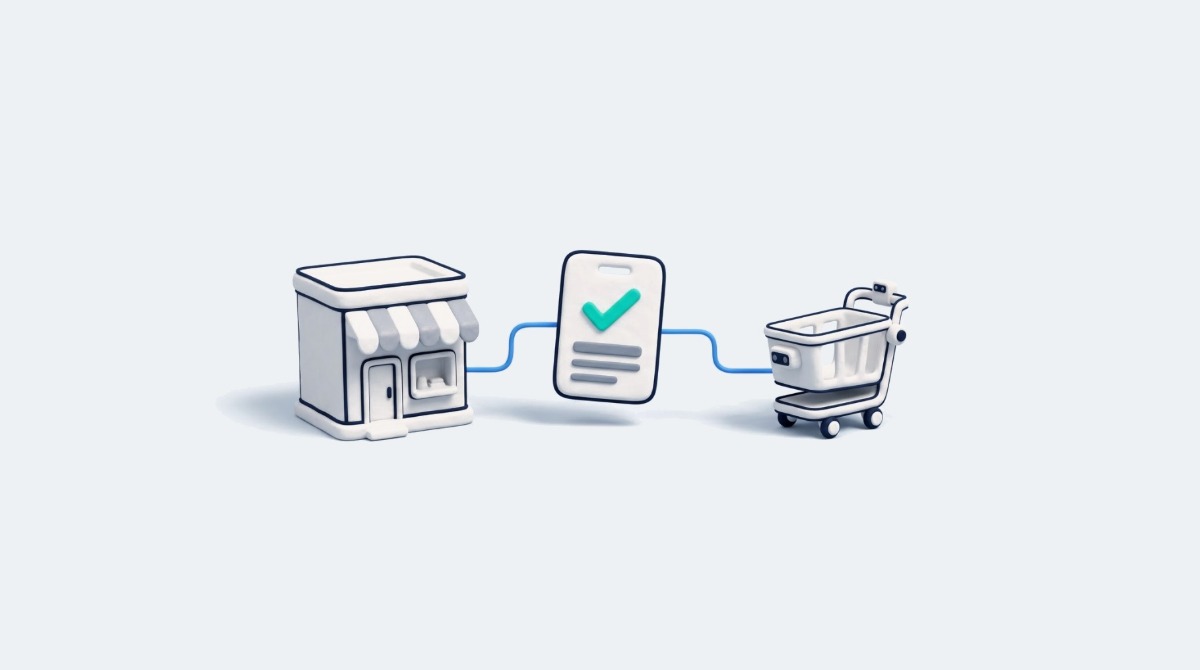
The risk in agentic buying is not that an agent makes a purchase. It is that the agent makes it from a seller nobody checked.
Picture an agent told to source 500 laptop stands for a distributed company. The cheapest listing comes from a supplier nobody on the team has dealt with, and the agent can compare, select, and pay within seconds. This is an illustrative scenario, but it marks the exact point where autonomous buying either works or goes wrong: before the order goes out, someone or something has to confirm that the organization receiving the money is the one it claims to be.
Product feeds and payment credentials answer part of that question, but they don’t establish a seller’s legal identity. A practical starting point is the Legal Entity Identifier, a standardized organizational code, and teams that manage many identifiers can use LEIadmin for LEI registration, renewal, verification, and monitoring through portfolio tools and API automation. This guide covers what an agent needs to check, how to wire that check into purchasing, and where identity data stops being enough.
Autonomous buying changes seller verification because the review step that used to sit between a person and a purchase order now has to happen inside software, in seconds. Agentic commerce allows AI systems to handle tasks such as product discovery, price comparison, and checkout according to rules set by a buyer. Each step may happen so quickly that a traditional review process has no room to run.
A human buyer who meets an unfamiliar supplier can read the website, ask a colleague, and phone the number on the invoice. An agent can only act on what it can query. That means the platform, not the agent, has to decide which facts count as evidence of identity and make them available as structured data. Anything left as prose on a storefront page is effectively invisible to the verification step.
The same logic already applies to product data. Fastlane’s guide to building a product feed that AI shopping agents trust covers keeping price, availability, and shipping facts accurate so an agent can rely on them. Seller identity is the other half of that trust: an agent can be given perfectly accurate product facts by a seller that is not who it says it is.
If you run a small team with a handful of recurring suppliers, this may feel like a problem for larger platforms. It becomes yours the day you let an agent reorder from a new vendor without a person in the loop. If you operate a marketplace or a procurement platform with thousands of sellers, it is already your problem, because identity checks that depend on manual document review cannot keep pace with software that buys in seconds.
Before paying, an agent should confirm four things about a seller: that the organization legally exists, that its registered name matches the payment account, which jurisdiction it is registered in, and whether its identity record has changed. Each question can be answered with structured data, and each failure points to a different kind of risk.
Legal existence is the baseline. A seller that cannot be found in an authoritative record is a seller the agent cannot hold accountable. The name match between the registered entity and the payment account matters because a mismatch is one of the simplest signals that money may be heading somewhere the buyer did not intend. Jurisdiction tells the platform which register to query and which rules apply to the transaction. A recent change to the identity record may be harmless, such as a merger or a rebrand, or it may be a reason to slow down, which is why the agent should see the change rather than only the current state.
Return to the laptop stand example. The cheapest listing may come from an unfamiliar supplier, so before placing the order the system should check that supplier’s organizational identity, return policy, and payment details. Conflicting records should trigger human review instead of an automatic purchase. In practice that means the agent still does the sourcing and comparison work, and a person only sees the orders where the evidence does not line up.
Identity records are not the only signal. For smaller suppliers that contact a store by email or phone, Fastlane’s review of ClarityCheck for contact verification shows a lighter, contact level check. It can add context before a conversation starts, but it complements an organizational record rather than replacing one.
Machine-readable identity means a seller’s identifiers and records follow a consistent format that software can read, compare, and validate without a person interpreting a web page. Pages written for people aren’t enough for autonomous verification, because an agent needs identifiers and records it can match field by field.
The Legal Entity Identifier, or LEI, offers one useful model. It assigns a unique 20-character code to a legal entity and connects that code with reference data such as its official name and registered address. The code format is defined by the ISO 17442 standard, and the reference data sits in a public record that anyone can query. Financial institutions and platforms managing many identifiers need to keep those records registered, renewed, and monitored at scale, which is the portfolio use case LEIadmin addresses.
An identifier alone doesn’t settle every trust question. Platforms should also check the record’s status, renewal date, and source. A current identifier tied to verified reference data provides stronger evidence than a business name copied from a storefront profile, because a storefront profile is written by the seller and an authoritative record is not.
There is a limit worth stating plainly: not every seller holds an LEI, and many small suppliers will not have registered one. A missing LEI is not evidence of a problem. It means the check needs a fallback path, such as the official business register for the seller’s jurisdiction, so that every seller still ends up with a recorded result.
Build seller verification into the purchasing workflow itself, so identity is checked at seller onboarding, at transaction screening, and in periodic account reviews instead of once on a form. Ecommerce teams can connect organizational data to each of those moments, which is similar to integrating inventory systems with various platforms: the value comes from the data staying connected after the first sync.
The emerging Agentic Commerce Protocol illustrates how agents, merchants, and payment services can exchange structured information during a transaction. Identity data can become another field in that exchange. Payment tooling is moving the same way. Fastlane’s coverage of Stripe and agentic commerce explains how a Shared Payment Token lets an agent pay without seeing the customer’s card details. That controls what an agent can spend. It does not tell the agent who is receiving the money, which is the gap an identity check fills.
A practical integration could follow three steps. First, collect the seller’s legal name, jurisdiction, and organizational identifier. Next, compare those details with an authoritative record through an API. Finally, assign a result such as verified, mismatch, or review required. Platforms should log the data source and timestamp too, since an audit trail helps teams explain why an automated purchase proceeded or stopped.
Here is how the three steps would play out on the laptop stand order, as an illustration. The platform collects the supplier’s legal name, country, and identifier from the listing. It queries the authoritative record and finds the name and jurisdiction match, but the bank details on the invoice belong to a differently named company. The result is review required, the order pauses, and a person asks the supplier for updated information. The log shows which record was checked and when. If the details had matched and the record was current, the result would be verified and the purchase would proceed without anyone being interrupted.
If you are early in this, a manual lookup and a logged result per new supplier may be all you need. The three steps matter more than the tooling, and they can be automated once the volume justifies it.
Choose the verification source by volume and by what the seller has: open LEI data for occasional checks, official business registers for sellers without an LEI, and API automation or portfolio tools when you manage many identifiers. No single source covers every seller, so most platforms end up combining two.
Choose the openly accessible LEI data published through the GLEIF API if you verify a modest number of sellers and want to query an authoritative record directly. Choose the official business register for the seller’s jurisdiction if the supplier is small and has no LEI, accepting that formats differ by country and that matching will need more care. Choose a portfolio and API tool such as LEIadmin if you register, renew, verify, and monitor many identifiers and want that handled through portfolio tools and API automation rather than by hand.
Whatever you choose, keep the output consistent. Every seller, whether checked through an LEI record or a national register, should end in the same three results so the agent and the review team work from one vocabulary.
No single database can eliminate ecommerce fraud or supplier risk, so a useful trust layer combines legal identity data with account history, payment signals, fulfillment performance, and marketplace policies. The agent can then apply thresholds that match the value and sensitivity of each purchase.
For example, a $40 office supply order from an established seller may pass with basic checks. A $25,000 equipment purchase from a new supplier should require a current organizational record, matching bank details, and human approval. These figures are illustrations rather than recommended limits, so set yours from your own fraud history and risk tolerance. Rules like these keep verification proportionate while preserving the speed that makes autonomous commerce useful.
Platforms should also define what happens when data conflicts. A name mismatch might come from a recent merger or a simple entry error. Pausing the transaction and requesting updated information is safer than letting the agent guess. The strongest shopping agents will know when to buy, when to ask for clarification, and when to hand the decision to a person.
The test for any agent-led purchase is simple: before the agent commits company funds, it should be able to identify the legal entity on the other side and show the evidence behind that conclusion. As agent-led transactions move from demonstrations into daily operations, verified organizational identity can become as routine as checking inventory.
That test also tells you where to start. Pick the purchases where a wrong seller would cost the most, add the collect, compare, and assign steps there first, and keep the log. Expand once the review queue shows you which conflicts are real and which are data entry noise.
An AI shopping agent can verify a seller’s legal identity only when the platform gives it structured records to check, because product feeds and payment credentials do not establish who the seller is. The agent needs the seller’s legal name, jurisdiction, and an organizational identifier, then a comparison against an authoritative record through an API. Without that, it can only read what the seller says about itself. Treat verification as a workflow the platform builds and logs, not a skill the agent has by default, and send conflicting records to a person instead of letting the agent guess.
An LEI, or Legal Entity Identifier, is a unique 20-character code assigned to a legal entity and linked to reference data such as its official name and registered address. It matters for agentic commerce because software can query the code and compare the returned record with what a seller claims, which is faster and more consistent than reading a storefront page. An LEI does not settle every trust question on its own. Check the record’s status, renewal date, and source, and combine it with payment, fulfillment, and account history signals.
An agent should pause the transaction and request updated information when a seller’s records conflict, rather than guessing which record is right. A name mismatch can come from a recent merger or a simple entry error, so the safest result is a review required status that routes the order to a person. Log the data source and timestamp for each check so the team can later explain why an automated purchase proceeded or stopped. Clear conflict rules also keep the agent useful, because it only escalates the cases that genuinely need judgment.
A seller without an LEI is not automatically a risk, but the platform needs a fallback check before an agent pays. Many small suppliers will never have registered one, so a missing code should trigger a different path rather than a rejection. Compare the seller’s legal name, jurisdiction, and registration details against the official business register for the place it is registered, and match them to the bank details on the invoice. For higher value orders, require that evidence and human approval. Keep the same verified, mismatch, or review required results so every seller flows through one process.
Each purchase should require verification proportionate to its value and the seller’s history. As an illustration, a $40 office supply order from an established seller may pass with basic checks, while a $25,000 equipment purchase from a new supplier should require a current organizational record, matching bank details, and human approval. These thresholds are examples, not rules, so set yours from your own risk tolerance and fraud history. Proportionate rules keep verification from slowing every order while preserving the speed that makes autonomous commerce useful.