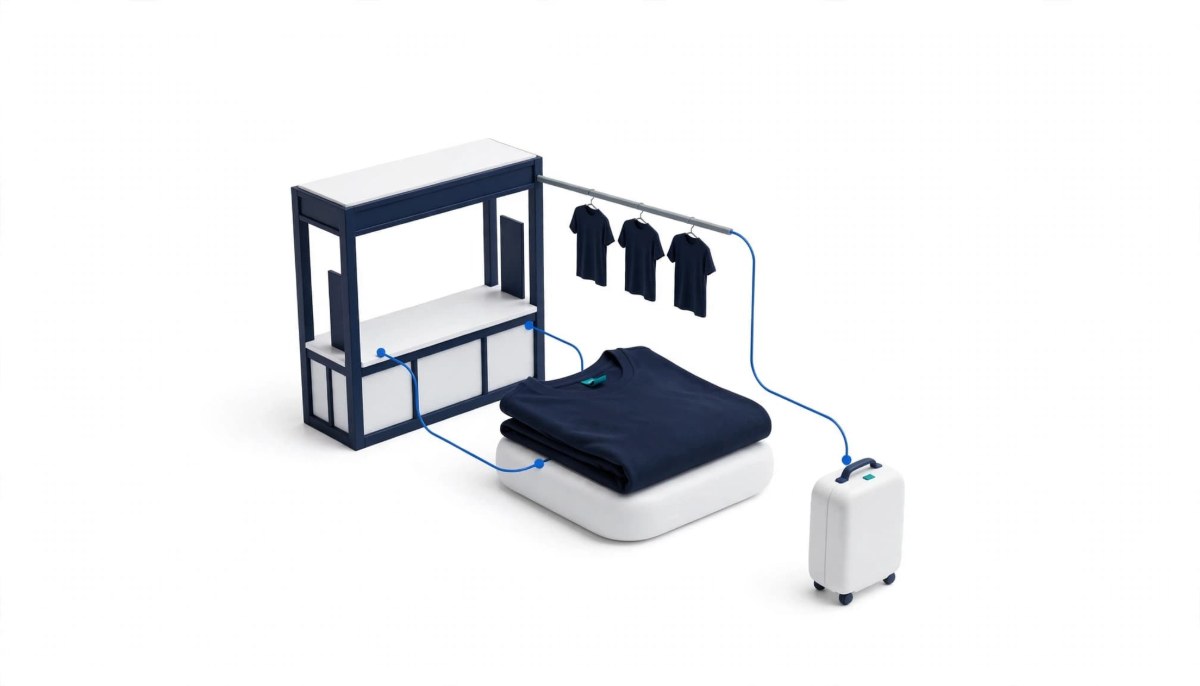
A shirt left in a drawer earns nothing, and one worn through an airport on the way home keeps working long after the show ends.
A well-loved branded T-shirt is likely to earn about 3,500 impressions over its lifespan, at an average cost of roughly a third of a cent each, according to ASI’s 2026 Ad Impressions research on T-shirts. That is the argument for ordering matching custom tshirts for a trade show team or corporate event, and it is also the reason to order them carefully, because the figure only holds for shirts that people actually wear.
ASI is the Advertising Specialty Institute, a trade group for the promotional products industry, so treat its numbers as industry research rather than neutral measurement. This guide uses them as a planning baseline, shows the arithmetic on a sample order, and is direct about the situations where a T-shirt is the wrong choice.
Matching T-shirts make your booth staff identifiable from across a crowded hall, which makes the booth easier to approach and saves visitors the effort of working out who works there. On a busy floor, that small saving in effort can be the difference between a visitor walking up and walking past.
The people at the booth matter more than the display around them. CEIR’s 2024 research on exhibition floor engagement, summarized by Trade Show Executive, identifies booth staff as critical to exhibitor success, and it reports that 84% of exhibitors invest in booth staff training. A shirt does not replace that training, but it supports it by making the trained people easy to find.
Matching apparel also changes how a team reads from the outside and how it feels from the inside. A group in the same garment looks like one team with a shared purpose, and wearing the same shirt can soften the visual gap between a founder and a first-year sales rep during a long, high-stakes event. When people feel part of one team, their energy and confidence tend to carry into warmer conversations with visitors. Treat that last point as a reasonable expectation rather than a measured result; the CEIR findings support staff quality, not shirts specifically.
For other ways to make a booth approachable, Fastlane’s roundup of vendor booth ideas for trade shows covers layout, lighting and visitor engagement, and it also suggests dressing staff in colors that match the booth and brand.
A well-loved branded T-shirt earns about 3,500 impressions over its lifespan, which works out to roughly a third of a cent per impression, based on ASI’s 2026 estimates. The inputs are survey answers: about 80% of consumers say they keep a promotional tee for at least a year, and roughly 90% say they wear one at least monthly. The impressions are modeled from those habits, not counted by a tracking pixel.
Here is the arithmetic on an illustrative order. Assume a decorated shirt costs $12, which is a placeholder, so use your own quote. Divided by 3,500 impressions, that is about $0.0034 per impression, or roughly a third of a cent, which matches the ASI average. An order of 40 shirts for staff and your best prospects would cost $480 and, if the ASI average held for every shirt, would produce around 140,000 impressions over time. The word to watch is “if.” A shirt that ends up in a drawer produces almost none, so the real number for your order depends on how many of those 40 get worn.
The reason the cost keeps falling is that each wear adds impressions without adding spend. When a recipient wears the shirt through an airport terminal, a coffee shop or a weekend errand, your brand reaches people who never visited your booth, and nothing about that exposure appears on your event invoice. Printed paper is the usual comparison. Flyers and brochures are easily misplaced or thrown away, while a shirt has a daily use that keeps it in circulation.
ASI’s wider findings point the same direction. As reported by Print & Promo, nearly 80% of U.S. consumers who receive a promotional item say they have a more favorable impression of the advertiser afterward, and three in four say they are more likely to do business with a company that gives them one. Those are stated attitudes in a survey, so they show goodwill, not a guaranteed sale.
People keep wearing a promotional T-shirt when it is comfortable and useful first and an advertisement second. The same Print & Promo summary of ASI’s study calls practicality the single most important factor in whether consumers keep a promotional product, and nearly eight in ten respondents say usefulness is a key reason they keep one.
That points to fabric and fit before graphics. Choose soft, breathable fabric and a modern cut, and ask your decorator for a physical sample before you commit to a full run. Fastlane’s guide to designing merch people actually wear makes the same case: design the piece as clothing first and branding second, judge the blank shirt by fabric weight, fit and construction in your hands, and keep the brand mark small enough that the shirt still works without it.
Rather than a large advertisement across the chest, tasteful logo placement, engaging artwork or a short, inspiring slogan turns a promotional item into something a person puts on for a weekend errand, which is where the impressions beyond your booth come from. A visitor who receives a shirt they like also tends to feel valued by the brand, a reciprocity effect that fits the survey result above. It is a pattern in survey answers, not proof that a shirt closes a deal.
Plan the order around who will wear each shirt: staff shirts first, attendee giveaways second, and sizes confirmed before the order closes. Staff shirts are the safe part of the order because the wearers are known and will wear them on the floor. Giveaway shirts are the speculative part, because you are betting that strangers will wear them again.
Order staff shirts for your confirmed roster plus a few spares for last-minute changes, then size the giveaway run to a number you could live with seeing go unworn. Sizing is an easy place to waste money. Collect sizes from staff before the order closes, and for attendee shirts use pre-event sign-ups or the demographics of past events to set the size mix, so you avoid leftover inventory and disappointed visitors.
Most decorators price by volume, so ask for quote tiers at two or three quantities rather than a single price. Print method changes the math too. Fastlane’s merch design guide notes that direct-to-garment printing suits small runs of up to about 100 units, screen printing is usually the better fit from about 100 units up, and embroidery suits simple logos at any size. If your quantity sits near that line, quote the same order two ways and compare.
Pick versatile colors that complement your brand palette, so leftover stock stays useful at the next event, a team offsite or a customer visit later in the year. Ask for a digital proof before production starts, and after the show, ask a sample of new leads in your follow-up whether they have worn the shirt. That one question gives you a real number to set against ASI’s modeled average.
A T-shirt is the wrong item when your audience will not wear it or when another item gives you more impressions for the money. ASI’s 2026 data shows the alternatives: branded tote bags have one of the lowest costs per impression of any category it analyzed, estimated at about a tenth of a cent, and outerwear averages about 9,000 impressions over its lifespan, at under half a cent per impression despite a higher price.
Fastlane’s guide to branded tote bags for ecommerce brands suggests totes work best as packaging inserts for merchants under $500K and as event or retention assets above $1M. That is editorial judgment rather than a sourced benchmark, so weigh it against your own audience.
Skip shirts, or shrink the order, in three situations. If your booth staff have not been trained to start conversations, spend the first dollars there, given the CEIR finding above. If your visitors are mostly formal buyers who will never wear a logo tee, a useful desk item fits better; Fastlane’s guide to promotional products and brand awareness argues that merchandise sticks when it solves a real everyday need for a defined audience. And if you cannot name who will wear the giveaway shirts, a smaller, better-made run is safer than a large one, which is the same case Fastlane’s guide to promotional products as a B2B growth channel makes for trade shows.
Stage changes the answer. If this is your first show, start with staff shirts only. If you exhibit several times a year, a reusable design plus a small giveaway run is easier to justify. For a broader look at uniforms and logo apparel beyond events, Fastlane’s guide to company logo T-shirts walks through a phased approach, from core team shirts to role-specific and seasonal apparel.
Custom T-shirts are worth ordering for trade shows when staff will wear them on the floor and the design is comfortable enough that attendees wear them again, and they are a weak choice when neither is true. Used well, they bridge the gap between temporary event marketing and sustained brand exposure, turning staff into identifiable representatives and attendees into walking advertisements who never appear on your invoice.
Treat ASI’s numbers as a planning baseline, order staff shirts first, put comfort and fit ahead of logo size, and measure how many shirts actually get worn. That last step is what turns a modeled average into your own result.
Order staff shirts for your confirmed roster plus a few spares, then size any giveaway run to a number you could live with seeing go unworn. There is no standard ratio that fits every show, because the right quantity depends on your roster, your budget and how many attendees you expect to engage in person. Ask your decorator for quote tiers at two or three quantities, compare the per-shirt price against the cost of leftover stock, and remember that staff shirts are the lowest-risk part of the order because you know exactly who will wear them.
They are a cost-effective option when people actually wear them. ASI’s 2026 research estimates that a well-loved branded T-shirt earns about 3,500 lifetime impressions at roughly a third of a cent each, but ASI is a promotional products trade group and the impressions are modeled from survey answers rather than measured. The return depends on wear: a comfortable shirt in a good fit is worn repeatedly, while a stiff, oversized or heavily branded one is not. Track your own result by asking new leads in your follow-up whether they have worn the shirt.
Staff should wear matching, comfortable apparel in your brand colors that makes them easy to identify from across the hall. A T-shirt suits a casual, consumer-facing show, while a polo or jacket may suit a more formal business exhibition. Whatever you choose, pick a fabric and fit people can stand and talk in all day, keep the logo clear but modest, and give everyone the same garment so the team reads as one group. Uniform apparel supports staff training, but it does not replace it.
Comfort, fit and a design that works as clothing make people wear a promotional T-shirt. ASI’s 2026 study, as reported by Print and Promo, calls practicality the single most important factor in whether consumers keep a promotional product. Choose soft, breathable fabric and a modern cut, keep the logo small or let the artwork carry the design, and request a physical sample before you order the full run so you can judge the fabric weight and fit in your hands.
Collect sizes from your staff before the order closes, and use pre-event sign-ups or the demographics of past events to set the size mix for attendee shirts. Keep a few spares for roster changes, pick versatile colors so leftover shirts stay useful at later events, and ask the decorator for a digital proof before production starts. Sizing mistakes are an avoidable source of wasted stock, so a few minutes of checking before you place the order saves money and keeps visitors from leaving without a shirt that fits.