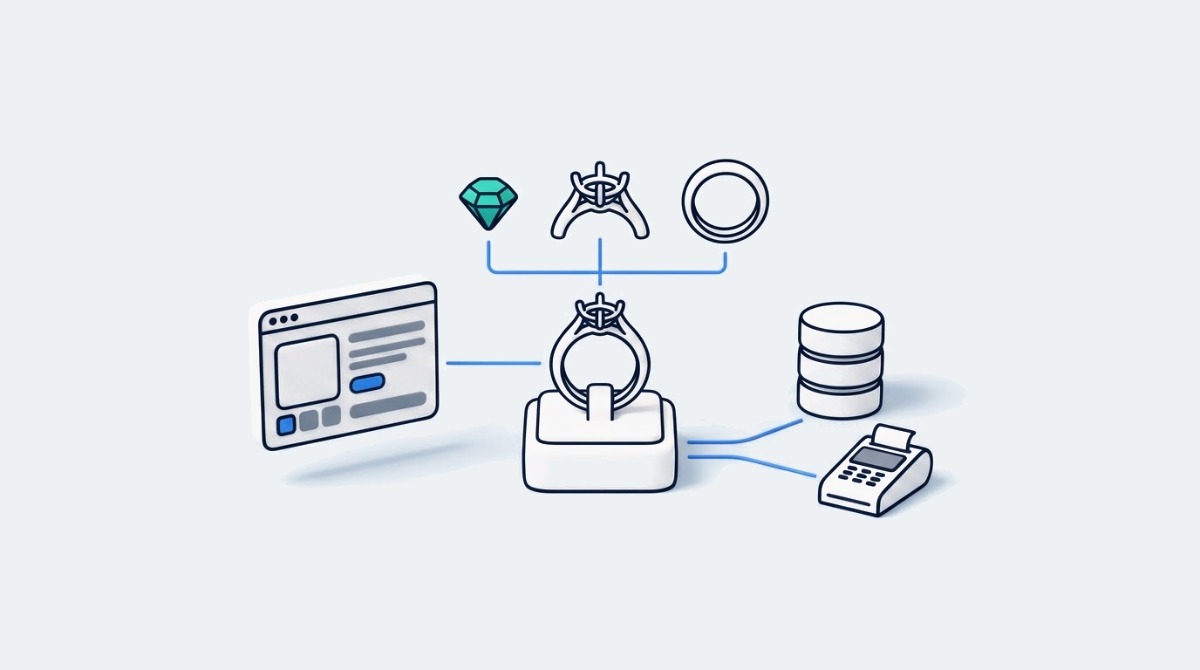
A ring that looks right on the product page but reaches the order with the wrong stone or price is a development problem, not a design problem. Pick the agency that has already solved yours.
A jewelry store has two kinds of work to do. Its product pages need to show stones, metals, and finishes clearly enough that shoppers can buy a piece they have never held. Behind those pages, the store has to manage variants, price changes, stock from shops or suppliers, and the business systems the company already uses.
Choosing a jewelry website development company often comes down to which of those jobs is harder for your business. This list compares ten agencies on the evidence they publish: the jewelry projects they have delivered, the platforms they work with, and the kind of project where that experience is most relevant. Between them, the companies cover Magento, Shopify, and BigCommerce, from complex catalogs and integrations to design-led brand stores.
Whidegroup, the contributor of this piece, is listed first. The other nine are grouped by the job each handles best and listed alphabetically within each group; the order is editorial, not a ranking. Elogic Commerce, MageCloud, Magneto IT Solutions, and scandiweb lead with complex Magento catalogs, migrations, and integrations, as Whidegroup does. Absolute Web, Aeolidia, By Association Only, GemFind Digital Solutions, and Swanky lead with Shopify design, jewelry-specific apps, or improving a store in place.
Every company here, whether a broad ecommerce firm or a specialist jewelry website development agency, has published evidence of work for a jewelry business: a case study, a portfolio entry, or a jewelry-specific service page. The research base is each agency’s own case studies and service pages plus its public Clutch or Shopify Partner Directory profile, reviewed in November 2026. None of the agencies were hired or tested for this article. Every agency was judged on the same four criteria: documented jewelry projects and the work delivered in them, the platforms it works with and the one used in its jewelry project, services that matter to jewelry stores (configurators, catalog and inventory integrations, migrations, design, and support), and how openly it publishes pricing. Configurator software vendors such as Gemist were considered and excluded, because they sell a tool rather than a store build. Whidegroup is the contributor of this piece and was held to the same standard as the other nine. The list is not exhaustive.
The ten agencies split between Magento-led engineering teams and Shopify-led design and app specialists. Pricing signals below are as of November 2026, taken from each agency’s own site or its public Clutch profile.
Whidegroup is a jewelry website development company that builds and supports Magento and Shopify stores for jewelry manufacturers, retail chains, wholesale suppliers, and independent makers.
Whidegroup’s jewelry work leans toward projects where standard platform features run out: large catalogs, made-to-order items, custom pricing logic, and connections to other business systems. Its services include custom Magento development for product configurators, dynamic pricing, and made-to-order flows; integrations with ERP, PIM, CRM, and POS systems, plus jewelry tools such as ring builders; Hyvä theme migration and customization; Shopify store design and development, including stores built from scratch and migrations between platforms; and performance optimization, support, and maintenance after launch. The company is based in Zaporizhzhia, Ukraine, and its jewelry page cites 14 years of Magento experience. Its featured jewelry project is the customization of a Magento store with more than 60,000 SKUs and worldwide delivery, which Whidegroup supports on an ongoing basis.
Whidegroup built a product configurator on a heavily customized Mageworx product options extension. The store now assembles product images from templates of individual parts, such as shanks, settings, and gemstones for rings. When a shopper picks a different stone or metal, the image, title, description, authenticity certificate, and price change together. The same details carry through to the cart, checkout, and confirmation emails. Prices follow the client’s own formulas, and the total a shopper sees is the total that reaches the order.
As of November 2026, Whidegroup’s jewelry page puts a fully functional store at about $6,500 for basic functionality, rising beyond $50,000 for advanced work. Payments are split by project milestones, each project includes up to three months of post-launch warranty, and builds from scratch typically take 8 to 20 weeks, with a Shopify store taking about two months.
Whidegroup’s standout strengths are configurator depth and catalog efficiency. The case study reports 67% less media volume, because configurable photos replaced unique images for every variant, and half as many product option templates to manage. It also reports lower load on reindexing, product editing, and feed generation, and new SKUs added through CSV files with minimal developer involvement. For a jeweler whose photography and catalog work grows with every metal and stone combination, that is the cost line the project attacks; Fastlane’s look at when CGI product images replace a photo shoot works through the same variant math from the content side.
The limitations are evidence breadth and price spread. The featured case study does not name the client, so ask Whidegroup for a reference or a live store you can test before relying on it. The server load improvement is reported without figures. The published range runs from about $6,500 to beyond $50,000 (as of November 2026), so the real number depends on scope, and configurator work sits toward the upper end. Whidegroup’s page also mentions BigCommerce only as an example platform, not one it builds on.
Whidegroup is the best fit for a jeweler on Magento, or moving to it, whose catalog has many configurable products, whose prices depend on materials or stones, or whose store must exchange data with other systems and keep evolving after launch. Skip Whidegroup if you need a BigCommerce build, or if you want branding, copywriting, and email marketing bundled with the site, which the design-led studios below offer.
Elogic Commerce is an engineering-led ecommerce agency for established brands running complex, integration-heavy Magento and Adobe Commerce stores, including stores that sell to both consumers and retailers.
Elogic Commerce works with Adobe Commerce (Magento), Shopify Plus, BigCommerce, and several enterprise platforms, and its Clutch profile lists Tallinn, Estonia as its base and 2009 as its founding year. For jewelry stores, the relevant services are Hyvä theme development and migration, ERP and other system integrations, B2B portals for retail partners and wholesale buyers, and ongoing performance and conversion work. Its featured jewelry project is Gabriel & Co., a New York fine jewelry manufacturer and retailer with a heavily customized Magento 2 store, a B2B retailer portal, and sales in US and Canadian dollars. The team rebuilt the storefront with Hyvä in phases. Integrations with Microsoft Dynamics 365 ERP, AWS S3, Zoho, Klaviyo, UPS, and NoFraud kept running throughout, as did the retailer portal. The customer-facing layer changed, and the business logic underneath stayed in place.
As of November 2026, Elogic Commerce’s Clutch profile lists a $25,000 minimum project and an hourly band of $50 to $99. Its own site describes both time and materials and fixed-price engagements.
Elogic Commerce’s standout strengths are performance work on stores that cannot go offline and integration depth. The Gabriel & Co. case study reports desktop Lighthouse scores above 90 after the first release, Core Web Vitals in the “Good” range, and a migration completed with zero downtime. Elogic’s own service pages add a 28% rise in ecommerce conversion and a 36% rise in organic traffic after the program; both are agency-reported figures from a single client.
The limitations are price floor and fit. A $25,000 minimum (as of November 2026) rules Elogic Commerce out for most small and independent jewelers. Elogic Commerce’s own materials also say it is not the right fit for creative-led or brand-first projects, so a jeweler whose main need is a new visual identity should look elsewhere.
Elogic Commerce is the best fit for an established jewelry brand on a customized Magento or Adobe Commerce store, particularly one selling to both consumers and retailers, where speed and frontend work must not interrupt ERP, shipping, or fraud integrations. Skip Elogic Commerce if your budget is under $25,000 or your project is mainly about branding and design.
MageCloud is a Magento, Shopify, and WooCommerce agency that fits jewelers running several brands or storefronts who want them on one Magento installation connected to an existing inventory system.
MageCloud was founded in 2014, and its Clutch profile lists offices in Chester, England, and Ivano-Frankivsk, Ukraine. It delivers custom builds, system integrations, and conversion work. For jewelry stores, its services include Magento 2 migration, Magento multi-store setup for several brands, stock system synchronization through product import and export, ring configurators and diamond search, and Magento maintenance. Its featured jewelry project is Windsor Fine Jewelers, a US retailer that MageCloud first supported on Magento 1 and then migrated, with its data, to Magento 2. The case study describes syncing the retailer’s custom stock management system with Magento through Firebear-based product import and export. The team also built a “Build Your Ring” feature for choosing ring color, center stone shape, and diamond type. Windsor’s second brand, Friedman’s, was moved from WooCommerce into the same Magento 2 installation.
As of November 2026, MageCloud’s Clutch profile lists a $5,000 minimum project and an hourly band of $50 to $99, the lowest published minimum among the Magento-led agencies on this list.
MageCloud’s standout strengths are multi-brand consolidation and stock integration. The case study reports both brands managed from one Magento admin panel, product data exchanged with the external stock system through automated import and export, and a diamond search with many filters, plus Searchanise site search and a Klaviyo integration. The low minimum also makes MageCloud a realistic option for a smaller jeweler with a Magento-specific problem.
The limitations are evidence and communication. The Windsor case study describes what was built but publishes no performance, conversion, or revenue figures, so ask for those on a call. Clutch’s review summary also notes that a few MageCloud clients mentioned minor communication challenges caused by language barriers, which is worth testing during scoping.
MageCloud is the best fit for a jeweler with several brands or storefronts who wants them consolidated on one Magento installation, connected to an existing stock system, with a ring builder or diamond search on top. Skip MageCloud if you want a design-led Shopify store with branding and copywriting from the same team.
Magneto IT Solutions is a Magento-focused development company suited to jewelry businesses whose main problem is an aging or unsupported platform, including multi-vendor marketplaces with large media libraries.
Magneto IT Solutions works with Magento, Adobe Commerce, Shopify Plus, BigCommerce, and other platforms, and its Clutch profile lists a team of 50 to 249 people. For jewelry stores, its services include replatforming and data migration to Magento 2, Magento upgrades and security work, Salesforce and other system integrations, and marketplace development with ongoing support. Its featured jewelry project is Louped, formerly known as “I Do Now I Don’t,” a US marketplace where buyers and sellers trade luxury jewelry. Magneto IT Solutions moved the multi-vendor marketplace to Magento 2, integrated Salesforce for order processing, and reworked the UI and vendor workflows. Its site also lists a B2B and B2C jewelry project for KGK Group.
As of November 2026, Magneto IT Solutions’ Clutch profile lists a $10,000 minimum project and an hourly band of $25 to $49, the lowest hourly band on this list.
Magneto IT Solutions’ standout strengths are data migration at scale and marketplace workflows. The Louped case study reports product listings, orders, and customer data migrated, including more than 400 GB of product images; search rankings preserved through the rebrand and migration; and simpler vendor onboarding, product management, and order processing. The rate band gives a budget-conscious jeweler access to a large Magento team.
The limitations are consistency and design focus. Clutch’s review summary notes that a few clients experienced challenges with technical depth on complex issues, and Magneto IT Solutions’ reviews vary more than most on this list, so check references from projects of similar complexity. The Louped case also centers on migration and integration rather than brand presentation, so a jeweler whose priority is a new look should weigh the design-led studios instead.
Magneto IT Solutions is the best fit for a jewelry business on an outdated or unsupported platform, including a multi-vendor marketplace with a large image library, that needs its data, rankings, and order flows moved to Magento 2 without losing them. Skip Magneto IT Solutions if your main need is a brand-led redesign or a Shopify-first build.
scandiweb is a large Adobe Commerce agency built for jewelry marketplaces, multi-brand retailers, and businesses planning several country-specific storefronts on one platform.
scandiweb was founded in 2003, lists offices in New York and Riga, Latvia, and its Clutch profile puts its team at 250 to 999 people. It works across Adobe Commerce (Magento), Shopify, BigCommerce, and enterprise platforms, and describes itself as a Hyvä Platinum Partner. For jewelry stores, its services include Magento and Adobe Commerce development and migration, multi-country and multi-currency store setup, localization and international expansion, and performance optimization, hosting, and support. Its featured jewelry project is JewelStreet, a luxury jewelry marketplace with more than 500 boutiques across 17 country-specific websites. scandiweb migrated the marketplace to Magento 2, carried over only the modules that were needed and well built, extended the database with custom tables and fields, and moved the data with migration scripts. A stress-test suite built into the deployment pipeline checked performance across thousands of SKUs, languages, currencies, and stock statuses.
As of November 2026, scandiweb’s Clutch profile lists a $25,000 minimum project and an hourly band of $50 to $99, with $50,000 to $199,999 as its most common reviewed project size.
scandiweb’s standout strengths are international scale and platform range. The JewelStreet case study reports 30 to 40% faster load times after code, database, and extension cleanup; support for six currencies across 17 country-specific websites; and a “Deliver By Date” filter that helps shoppers choose gifts that arrive in time for a special occasion. scandiweb has also published a Magento 1 to Shopify migration for a luxury jewelry brand, so it is not locked into recommending Magento.
The limitations are cost and pace. A $25,000 minimum and a typical project range above $50,000 (as of November 2026) put scandiweb beyond most single-store jewelers. Clutch’s review summary also notes occasional timeline delays caused by external dependencies or project complexity, so build buffer into any launch date tied to a holiday season.
scandiweb is the best fit for a jewelry marketplace, a multi-brand retailer, or a jeweler planning several country-specific storefronts with multiple currencies on one platform. Skip scandiweb if you run one store in one market and your budget sits below its $25,000 minimum.
Absolute Web is a Miami full-service ecommerce agency that suits small and medium-sized jewelry brands that want to improve an existing store in place rather than replatform.
Absolute Web was founded in 1999, lists offices in Miami and Lisbon, and is a Shopify Premier Partner that also lists Adobe Commerce and BigCommerce partnerships. For jewelry stores, its services include UX and UI redesign with a mobile focus; search, payment, and help desk integrations; conversion rate optimization; and BigCommerce, Shopify, and Adobe Commerce development. Its featured jewelry project is Auvere, a luxury jewelry brand whose default BigCommerce search did not serve its catalog well and whose store offered more than 20 currencies. The Auvere case study describes UX and mobile improvements, Klevu search, Affirm pay-over-time financing, and Gorgias customer support. The store stayed on BigCommerce, which shows how much an existing store can improve without a migration.
As of November 2026, Absolute Web’s Clutch profile lists a $10,000 minimum project and an hourly band of $100 to $149, and Clutch’s review summary describes projects ranging from $5,000 to $450,000.
Absolute Web’s standout strengths are data-led cleanup and integration breadth. The Auvere case study reports the currency list cut from more than 20 to nine, based on Google Analytics 4 data; default search replaced with Klevu for better product discovery; and flexible payments through Affirm with support requests handled in Gorgias. Cutting currencies to the ones customers actually use is the kind of subtraction that often helps more than adding features.
The limitations are measurement and jewelry-specific depth. The Auvere case study reports improved engagement and conversions without publishing numbers, so ask for before and after figures. Its published jewelry work is CRO and integration, not a configurator or material-based pricing build. Clutch’s review summary also notes a few clients felt Absolute Web’s marketing services trail its development work.
Absolute Web is the best fit for a small or medium-sized jewelry brand on BigCommerce, Shopify, or Adobe Commerce that wants better search, payments, support, and mobile UX without replatforming. Skip Absolute Web if your main requirement is a custom ring configurator or complex material-based pricing logic.
Aeolidia is a Seattle Shopify design studio that fits independent and handmade jewelry brands that want a store built around brand presentation and clear product content.
Aeolidia was founded in 2004, has been a Shopify Partner since 2012, and is now a Shopify Plus Partner with a women-led, all-senior in-house team. Its Shopify website services sit alongside branding and email marketing, which makes it as much a jewelry website design company as a development partner. Its services include custom and simpler Shopify design, brand strategy and identity design, ecommerce copywriting and illustration, and Klaviyo email and SMS marketing plus SEO. Its featured jewelry project is Hello Adorn, a handmade fine jewelry brand with a high-traffic website that wanted fewer customer service requests, higher conversion, and more efficient operations. Aeolidia created a custom Shopify Plus design with editorial photography, new copy, and painterly illustrations, keeping the product content and the visual presentation consistent.
As of November 2026, Aeolidia’s Clutch profile lists a $10,000 minimum project and an hourly band of $200 to $300, and its Shopify Partner Directory listing shows selected services starting from $6,000.
Aeolidia’s standout strengths are brand, copy, and site from one team. The Hello Adorn case study describes product education pages designed to answer questions before shoppers contact the store, a responsive layout designed for desktop, tablet, and mobile screens, and email marketing as part of the project scope. For a small team, product education that heads off routine questions saves support time every week after launch.
The limitations are price and technical scope. Aeolidia’s hourly band is the highest on this list (as of November 2026). The Hello Adorn case describes deliverables rather than measured results, so ask what changed in support volume and conversion after launch. Aeolidia’s published work is Shopify-only and design-led, with no ERP, configurator, or Magento projects.
Aeolidia is the best fit for an independent or handmade jewelry brand on Shopify that wants branding, copy, illustration, and the store designed together, with email marketing in the same engagement. Skip Aeolidia if you need ERP or POS integration, a custom configurator, or work on Magento.
By Association Only (BAO) is a UK Shopify Plus agency for design-conscious luxury brands that sell in several countries and want personalization built into a Shopify store.
BAO was founded in 2010, is based in St Ives, Cambridgeshire, and has been an active Shopify Partner since April 2013. It presents itself as a partner for design-conscious luxury brands, and its jewelry clients include Astrid & Miyu, Purelei, and Daniella Draper. It works on both projects and retainers. Its services include Shopify and Shopify Plus design and development, migration to Shopify from other platforms, international selling with Shopify Markets and Global-e, and app integrations for personalization, search, loyalty, and email. Its featured jewelry project is Daniella Draper, a British designer jewelry brand with six UK stores, which moved its online store from Magento to Shopify. The case study covers a redesign, conversion work, and a heavily customized add-to-cart system for products personalized with Zakeke, a 3D product customizer. A personalized item has to look right on the product page and reach the order with every choice the customer made.
As of November 2026, BAO does not publish a rate card or minimum project size, so pricing starts with a scoped quote or retainer proposal.
BAO’s standout strengths are international setup and personalization. The Daniella Draper case study reports parallel international stores with Shopify Markets, Global-e checkout, and a store switcher; ERP integrations and improved product data management; and product personalization plus Klevu, Klaviyo, LoyaltyLion, and Gorgias integrations.
The limitations are price visibility and stack weight. With no published pricing, budgeting starts on a sales call. The case study lists features rather than measured results. The stack it describes (Zakeke, Global-e, Klevu, Klaviyo, LoyaltyLion, and Gorgias) carries its own monthly fees, so total the app costs alongside the build quote and confirm each one earns its place before launch.
By Association Only is the best fit for a jewelry brand with a strong visual identity that sells in several countries and wants personalization built into a Shopify Plus store. Skip BAO if you run a small, single-market store or need a published price before a first conversation.
GemFind Digital Solutions is a jewelry-only Shopify partner and app developer that suits independent and multi-location jewelers who want store design, SEO, and advertising from one team.
GemFind Digital Solutions has worked in the jewelry industry since 1999 and lists Newport Beach, California as its base. It designs Shopify websites, offers marketing services, and develops its own jewelry apps, including JewelCloud, RingBuilder, and DiamondLink, and it describes itself as the only Shopify Plus Partner exclusively serving the jewelry industry. Its services include Shopify and Shopify Plus website design and development, JewelCloud supplier catalogs, RingBuilder, DiamondLink, and related apps, and Edge POS integration with staff training. GemFind does not publish development case studies. Its five written case studies cover SEO and advertising and report traffic, store visits, and sales, not what was built. Evidence of its web design work comes from a portfolio of more than 30 jewelry store sites, presented as a gallery of live sites with no notes on scope, platform, or results.
As of November 2026, GemFind sells Bronze, Silver, Gold, and Platinum Shopify website packages on an “inquire about pricing” basis. On the Shopify App Store, its RingBuilder app lists at $295 per month (TryOn adds $50 per month) and StudBuilder at $195 per month.
GemFind Digital Solutions’ standout strengths are jewelry-specific tooling and POS data work. Its RingBuilder app integrates with diamond sources such as IDEX, Polygon, RapNet, and Nivoda, according to its App Store listing. GemFind’s Edge integration page explains a common starting point: product data sent from Edge to Shopify arrives with blank website fields and no structure for online shopping. GemFind describes products organized into categories with structured attributes and advanced filters, staff trained to enter website-ready titles and descriptions in Edge, and optional AI-generated product copy for large catalogs through GemText AI.
The limitations are proof of build and recurring cost. Without development case studies, you cannot see what GemFind delivered on a comparable store, so ask for a walkthrough of a live site with similar requirements. App subscriptions add a monthly cost on top of the website package, and the RingBuilder listing notes that moissanite and other gemstones are not supported.
GemFind Digital Solutions is the best fit for an independent or multi-location jeweler on Edge POS who wants a Shopify store, supplier catalogs, a ring builder, and SEO and advertising from one jewelry-specialist team. Skip GemFind if you need complex custom development or published evidence of build scope before you buy.
Swanky is a Shopify Plus agency that fits established jewelry retailers moving to Shopify Plus who want one agency for the launch and for growth work afterward.
Swanky was founded in 2010 in Exeter, UK, and has teams in the UK, Australia, and France. It has worked with Shopify brands since 2012, became a Shopify Plus Partner in 2016 (one of the first three in Europe, by its own account), and is now a Shopify Platinum Partner. Its jewelry portfolio includes Daisy, Medley, and Essential Jewellery. Its services include migration to Shopify Plus, jewelry website design and branding, Shopify development and integrations, and CRO, email, paid media, and SEO after launch. Its featured jewelry project is Essential Jewellery, a family-run retailer with seven UK stores, which moved from Magento to Shopify Plus. Along with the migration, the Swanky team created a new visual identity for the online store: a refined color palette, serif typography, and image-led category pages that put the retailer’s lifestyle photography first.
As of November 2026, Swanky’s Clutch profile lists its minimum project size and hourly rate as undisclosed, so pricing is quote-based.
Swanky’s standout strengths are migration plus ongoing growth and in-house control. The Essential Jewellery case study reports team members able to create page elements and manage orders without coding knowledge, and small site changes made in-house with no need to wait for a developer. Swanky’s own case study headline also reports a 32% year over year revenue increase after the migration; that is an agency-reported figure and likely reflects the rebrand and marketing work as well as the platform move.
The limitations are platform and price visibility. Swanky works only on Shopify, so a jeweler staying on Magento or BigCommerce is outside its scope. With pricing undisclosed, budget comparison starts after scoping.
Swanky is the best fit for an established jewelry retailer moving from Magento or another platform to Shopify Plus that wants the migration, a brand refresh, and post-launch CRO and marketing from one agency. Skip Swanky if you plan to stay on Magento or BigCommerce.
Choose a jewelry website development company by testing whether its published evidence matches your hardest requirement, not by comparing portfolios in general. The profiles above show where each agency has published evidence. On a shortlist call, test whether that evidence applies to your store. The table below helps separate relevant experience from general claims.
Good answers are specific to your requirements. If an agency describes its process only in general terms, ask it to walk you through similar functionality in a live store or case study. For a migration, also ask how rankings will be protected; Fastlane’s guide to Shopify development and SEO covers the redirect and structured data checks to run before and after a rebuild, and its guide to choosing a Shopify development partner covers contract and ownership questions that apply to any agency.
The right agency depends on which job is harder for your store: the logic behind the product page, the systems behind the catalog, or the brand in front of the shopper. If your prices depend on metal and stone choices and shoppers configure rings or pendants, Whidegroup’s configurator work is the closest published match, and Elogic Commerce fits when the same store also runs a B2B retailer portal and an ERP and the budget clears $25,000 (as of November 2026). If you run two or more brands that should share one Magento admin and one stock system, MageCloud has done exactly that, at the lowest minimum among the Magento teams. If the problem is an aging platform or a multi-vendor marketplace with a large image library, Magneto IT Solutions has moved one, at the lowest hourly band here. If you are expanding into several countries and currencies on one platform, scandiweb’s JewelStreet work is the most relevant.
On the Shopify side, the split is about brand and scale. An independent or handmade brand that wants branding, copy, and the store designed together fits Aeolidia. A luxury brand selling internationally, with personalized products, fits By Association Only. An established retailer leaving Magento for Shopify Plus, with growth marketing afterward, fits Swanky. An independent jeweler on Edge POS who needs supplier catalogs and a ring builder more than custom code fits GemFind Digital Solutions. If you are happy with your platform and want better search, payments, and mobile UX, Absolute Web’s in-place approach avoids a migration entirely.
The honest trade-off is complexity. A custom configurator, a multi-store setup, or a six-app personalization stack is something you maintain for years, with upgrades, fees, and developer time attached. A jeweler with a small catalog and no custom options usually gets more from clean product data, good photography, and a well-chosen theme than from a custom build. Buy the complexity only when your hardest requirement actually demands it.
There is no single best jewelry website development company, which is why this list is grouped by job rather than ranked. You don’t need to contact all ten. Use your hardest requirement to narrow the list to two or three agencies with relevant published work. For a Magento store with complex configurable products or several integrations, start with the Magento-led profiles. If supplier catalogs, diamond data, or POS connections are the main concern, look at the agencies with jewelry-specific integrations. For a design-led brand on Shopify, focus on the studios with strong Shopify design work.
Then send each shortlisted agency the same written requirements and compare how specifically each one responds, including what is in scope, what support costs after launch, and which apps or licenses you will pay for monthly. Once the store is live, Fastlane’s strategies for growing an ecommerce jewelry store cover the traffic and conversion work that follows the build.
Choose a jewelry website development company by starting from the hardest part of your store and shortlisting agencies that have published a comparable project. Begin with your platform and that requirement, whether it is a ring configurator, a supplier diamond feed, or a POS stock sync. Then compare platform experience, what each proposal includes, and how each agency handles support after launch. Ask each one to demonstrate or explain how it built similar functionality in a live store or case study. A practical rule: if an agency cannot show or describe work close to your most difficult requirement, keep looking, however impressive the rest of its portfolio is.
No single ecommerce platform is best for every jewelry store; the choice depends on how much customization you need, which systems must connect, your budget, and who will own the technical side. Magento Open Source and Adobe Commerce give developers deep control over catalog logic, pricing rules, and integrations, but Magento Open Source is self-hosted and both editions need regular upgrades and developer involvement. Shopify is a hosted platform, so the provider runs the infrastructure, and stores are extended with themes, apps, and custom app development, with some features available only on Shopify Plus. BigCommerce is also hosted and extended with themes and apps, with some features tied to the plan.
A jewelry ecommerce website built by an agency typically starts around $5,000 and can pass $50,000 for configurators and integrations, based on pricing the agencies on this list published as of November 2026. Whidegroup’s jewelry page puts a functional store at about $6,500 and advanced work beyond $50,000. On Clutch, MageCloud lists a $5,000 minimum project; Magneto IT Solutions, Absolute Web, and Aeolidia list $10,000; and Elogic Commerce and scandiweb list $25,000. Hourly bands run from $25 to $49 at Magneto IT Solutions to $200 to $300 at Aeolidia. Apps add recurring costs: GemFind’s RingBuilder lists at $295 per month on the Shopify App Store.
A jewelry web design and development service should include discovery, design, catalog setup, development and integrations, migration, testing, and a warranty period after launch. Discovery covers your products, operations, and requirements; design covers catalog, product, and checkout pages; catalog setup covers product options and variants; integrations connect systems such as an ERP or POS; and migration covers data and redirects if you are moving from another platform. Ring builders, diamond search, 3D viewers, and virtual try-on are optional features. Agree whether each belongs in the first release or a later phase, because each one adds design, development, and testing work.
Jewelry store website developers do not need to work only with jewelry brands, but relevant experience shortens the learning curve. A team that has built jewelry stores has likely dealt with product configuration, diamond and gemstone data, image-heavy catalogs, and purchase flows for custom or made-to-order pieces. That matters most when a price depends on metal and stone choices, or when a supplier feed must stay in sync with the store. For a simpler catalog, a strong general ecommerce agency can do the job, as long as it can show comparable work on variants and integrations.