

If you’ve ever sat in a meeting where someone casually dropped “martech stack” into conversation and you nodded along while quietly Googling it under the table, then this one’s for you.
In this guide, we’ll cover everything you need to know, including:
By the end, you’ll have a better idea of what you’ve got, what you might be missing, and where to go next.
A martech stack is the collection of marketing technology a business uses to plan, run, and measure its marketing. Your email platform, your CRM, your analytics tool – that collection of tech is your martech stack.
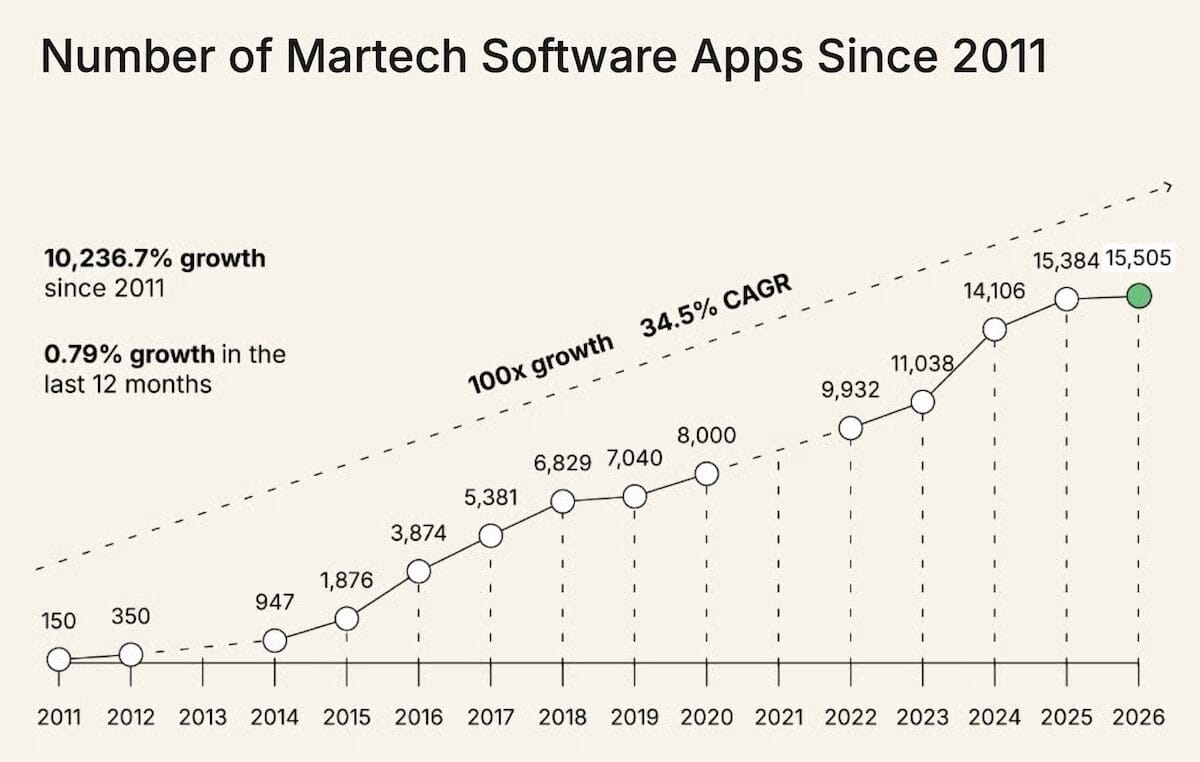
According to the State of Martech 2026 report, the martech landscape now includes over 15,000 tools. That’s a lot of options, and a lot of potential for your stack to become more complicated than it needs to be. The challenge for most marketing teams is knowing whether the ones they already have are working together properly.
Your martech stack is what sits between your marketing ideas and your marketing results. When it’s working well, your data flows freely, your campaigns run without manual intervention, and your team spends less time on admin and more time on strategy.
A well-connected stack gives you a clearer picture of your customers at every stage, from the moment they first discover your brand right through to repeat purchase and retention. That means better targeting, more relevant experiences, and a much stronger understanding of what’s driving results.
When it’s not working well, you end up with gaps in your data and a customer experience that feels inconsistent, which is why getting it right matters.
Every martech stack looks a little different depending on the size of the business, the channels they use, and the goals they’re working towards. But most stacks are built around a core set of tools that cover the same fundamental needs.
Your CRM is where your customer data lives. It stores contact information, purchase history, interactions, and anything else that helps you understand who your customers are and where they are in their journey with you.
Your email platform is where you build, send, and track email campaigns. It’s one of the most direct ways to reach your audience and, when connected to your CRM and other data sources, one of the most effective.
Automation tools let you set up campaigns and customer journeys that run in the background, triggered by customer behavior, such as welcome emails, abandoned cart reminders, and re-engagement campaigns.
Your analytics tools tell you what’s working and what isn’t. From website traffic and email open rates to revenue attribution and customer lifetime value (CLV), good reporting is what turns data into better decisions.
Your CMS is where your website and blog content lives. It’s how you publish and manage the content that attracts, informs, and converts visitors.
Personalization tools let you create bespoke customer experiences, whether that’s dynamic content in an email, product recommendations on your website, or targeted messaging based on behavior.
Paid media tools help you reach new audiences and re-engage people who’ve already shown interest in your brand. They work best when connected to your customer data, so your targeting is as accurate as possible.
Buying a great tool and then watching it sit in isolation can be frustrating, but a well-connected stack fixes that. Data moves freely between your tools, so no one has to manually export, upload, or piece it together. When your tools are connected, every action feeds the next one:
Everything talks to everything else, and your marketing becomes more relevant as a result.
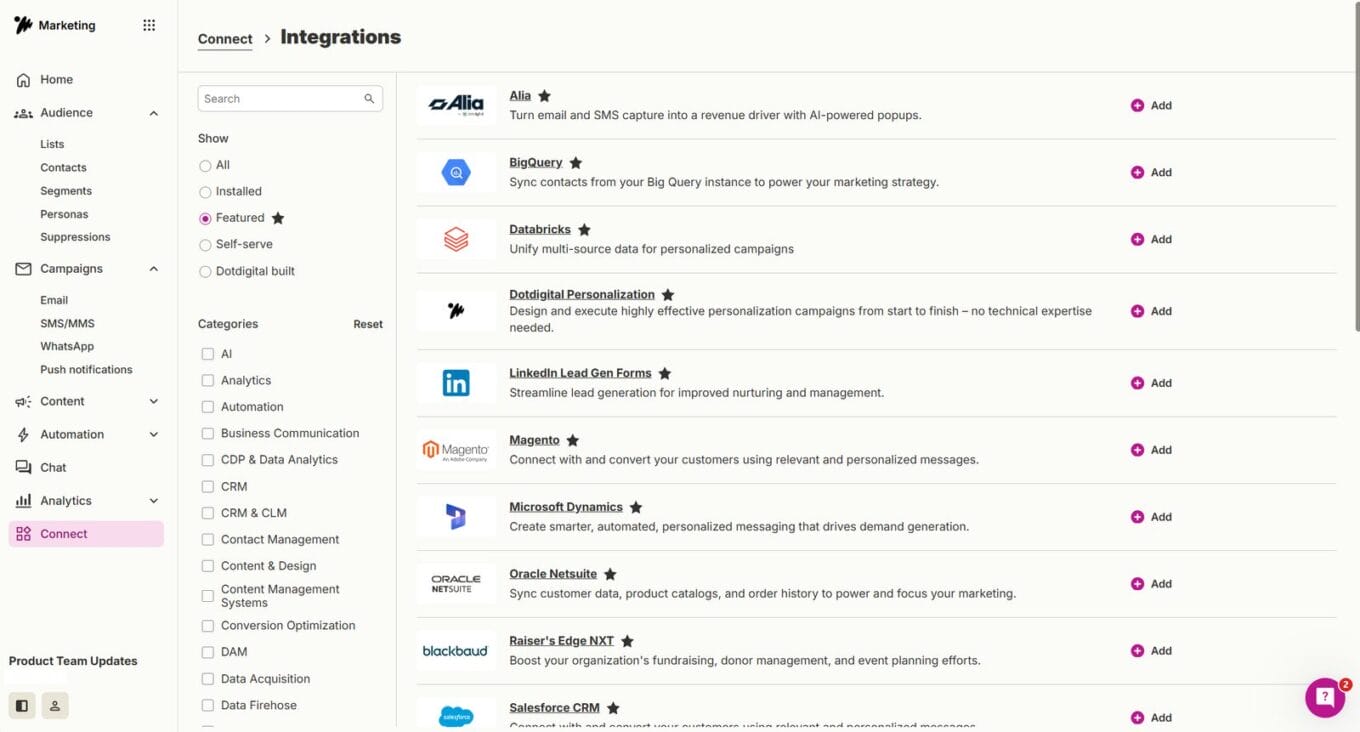
The most common way tools connect is through integrations, either native connections built directly between platforms or via Application Programming Interface (APIs) that let different systems share data. Some businesses also use a customer data platform (CDP) to act as a central hub, pulling data from every tool into one place and pushing it back out again so every platform is always working from the same customer profile.
When your stack isn’t connected properly, it shows quickly. You end up with:
More tools don’t mean better marketing. The goal is a stack where everything connects, everyone can see the same customer, and nothing gets lost on the way.
Your martech stack does more than just support your marketing. It maps directly to how your customers move through their journey with your brand. Different tools do different jobs at different stages, and understanding that is what helps you spot where your stack might be letting you down.
This is where potential customers first discover you. Your ads, social media, SEO, and content tools are doing the heavy lifting here. The goal is getting in front of the right people at the right moment.
Once someone knows you exist, they start weighing up their options. Your CMS, personalization tools, and email platform help you stay relevant during this stage, giving people the information they need to move forward with confidence.
Your ecommerce integrations, forms, landing pages, and automation tools are what close the gap between interest and purchase. A well-timed abandoned cart email or a personalized offer can make the difference here.
Getting a customer is one thing, but keeping them is where the real value is. Your CRM, loyalty platform, and automation tools work together to keep customers engaged, reward repeat purchases, and spot early signs that someone might be drifting.
Happy customers tell other people. Review platforms, referral tools, and social proof integrations help you capture that goodwill and put it to work, turning your best customers into your best marketing asset.
The important thing to remember is that your stack needs to support the full journey, and not just parts of it. Gaps at any stage mean customers slipping through, and that’s where the new blog we mentioned earlier comes in handy.
The martech landscape has always moved fast. But right now, it’s changing in ways that are reshaping how marketing teams work.
A year ago, AI in marketing meant content suggestions and subject line recommendations. Now it’s doing a lot more. AI agents can build audience segments from a plain-English description, write and refine campaign content, and show insights from your data, all without you having to log into five different tools to do it. The shift from AI as a helper to AI as a doer is happening quickly, and the stacks that are built to take advantage of it will have a real edge.
Model Context Protocol (MCP) is a relatively new standard that lets AI tools connect directly to your marketing platforms. In practice, that means you can ask questions about your campaign performance, contact data, or customer behavior directly inside tools like ChatGPT, Claude, or Gemini, without switching tabs or logging into your marketing platform. It’s early days, but MCP has the potential to change how marketers interact with their entire stack.
The days of adding a new point solution for every marketing problem are fading. Marketers are increasingly looking for platforms that do more in one place, reducing the number of integrations to manage, logins to remember, and places where customer data can get lost.
With third-party cookies largely gone and privacy regulations tightening, the data you collect directly from your customers has never been more valuable. The stacks best positioned for the future are the ones built around first-party and zero-party data, such as preference centers, forms, behavioral tracking, and loyalty programs that give customers a reason to share.
Whether you’re starting from scratch or taking stock of what you’ve already got, the process is the same. It starts with seeing what’s working and what isn’t.
The biggest mistake marketers can make when building a stack is starting with the technology rather than the problem they’re trying to solve. Before you look at any platform, get an idea of what you’re trying to achieve. More subscribers? Better retention? Faster campaign turnaround? Your goals should drive your tool choices, not the other way around.
Most marketing teams are sitting on tools they don’t use, tools that duplicate each other, and tools nobody quite knows how to turn off. A quick audit of your current stack – what you have, what it does, what it costs, and whether it connects to everything else – is a useful starting point. You might find you need less than you think.
A tool with slightly fewer features that connects well with everything else in your stack will almost always outperform a feature-rich tool that sits in isolation. When you’re evaluating anything new, the first question should be how well it plays with what you already have.
Follow the data. Where does it come in? Where does it go? Where does it get stuck? A good stack has clean, consistent data moving freely between tools, so your CRM, your email platform, your analytics, and your personalization tools are all working from the same customer picture.
There’s always a temptation to add more. A new AI tool here, a specialist platform there. But every tool you add is another integration to manage, another login to remember, and another place your data can get lost. Build for what you need now, which also gives you room to grow.
Your stack should change as your business changes. What worked two years ago might not be the right fit today. A regular review, even just once a year, helps you stay on top of what’s earning its place and what’s quietly adding cost without adding value.
Every stack looks different, but here’s a simple example of what a typical ecommerce brand might be working with:
| Layer | Tool type | What it does |
| Data | CRM + CDP | Stores and unifies customer data from every touchpoint |
| Communication | Email platform + SMS | Sends campaigns and automated messages across channels |
| Automation | Marketing automation | Runs customer journeys triggered by behavior |
| Website | CMS + personalization | Manages content and tailors the experience for each visitor |
| Acquisition | Ads and retargeting | Reaches new audiences and brings back high-intent visitors |
| Insight | Analytics and reporting | Tracks performance and attributes revenue to the right campaigns |
In Dotdigital’s case, a lot of these layers live in one platform, which means less time managing integrations and more time using your data. But whether you’re using one platform or several, the principle is the same. Each layer needs to feed into the next, so your marketing always reflects what your customers are actually doing.
Building a martech stack isn’t a one-time project. It’s something you come back to as your business grows, your goals shift, and new tools worth adding come along. The marketers with the strongest stacks aren’t necessarily the ones with the most tools. They’re the ones who are honest about what’s working, quick to cut what isn’t, and deliberate about how everything connects.
If you’ve read this far, you’re already ahead when it comes to understanding what a martech stack is and how to get the most from it.
The next question is whether your current stack is helping you hit your goals or quietly getting in the way, which is something we dig into in our next blog. Find out how to spot and fix the gaps in your marketing tech stack.




