

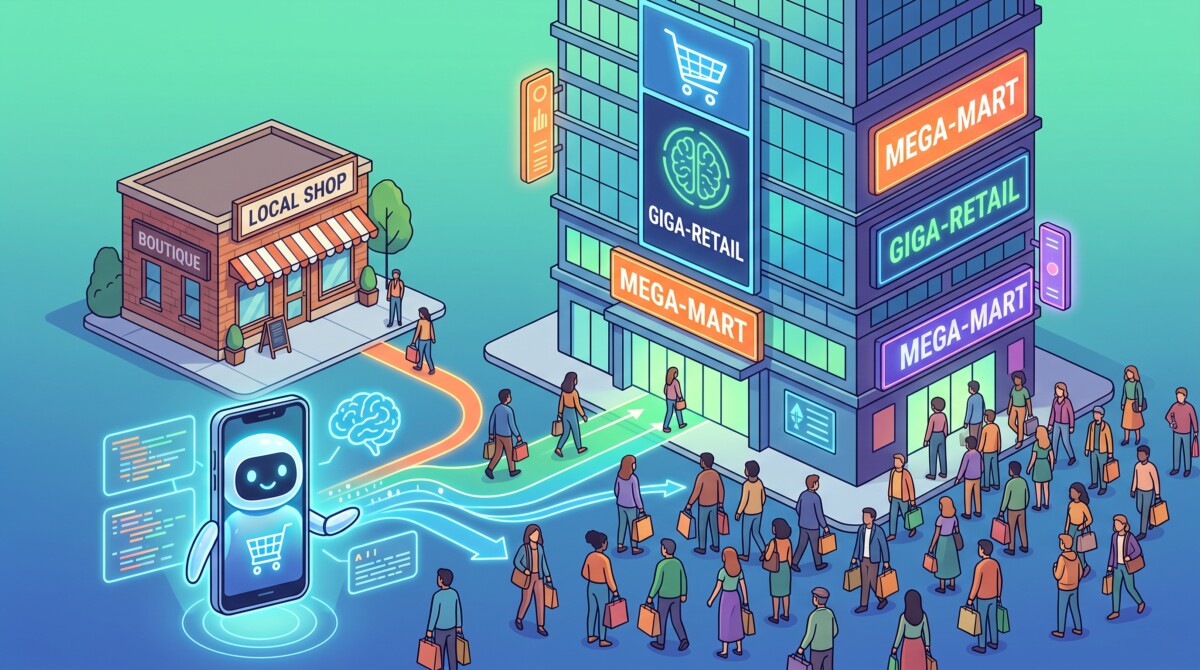
Yes, for broad “where to buy” questions. A September 2026 study of roughly 460,000 AI answers found that, head-to-head, ChatGPT and Google’s AI picked the bigger store 90-94% of the time. Shopify brands win on specific needs that no chain owns.
Shopify’s new AI can build you a custom store in an afternoon. A different set of AI tools decides whether any shopper gets sent there, and right now those tools pick the bigger store nine times out of ten.
I wrote about Shopify Canvas and what gets expensive once custom store design is cheap. The short version: Sidekick can now build a fully custom storefront in an afternoon, so design stops being the hard part. The day before Canvas launched, a much less cheerful piece of research came out. A study of about 460,000 AI shopping answers found that when ChatGPT and Google’s AI tools were asked where to buy something, they named a national chain most of the time. When asked to choose between a big store and a small one, they picked the big one 90-94% of the time.
Put those two stories side by side, and you get the question I think matters most for Shopify brands over the next 18 months. If AI makes every store look great, what decides which store the AI actually sends people to?
This piece is for Shopify brands that sell anything a big retailer could also sell, and for brands that have already put products on shelves at Target, Walmart, Sephora, or Best Buy. I’ll walk through what the study found, what it didn’t measure (which matters more than the headlines suggest), and where a $500K brand still beats a $50 billion one.
The study measured which stores AI tools recommend when shoppers ask where to buy everyday products, and it found a heavy tilt toward large retailers across ChatGPT, Gemini, Google AI Mode, and Google’s AI Overview. The AI retailer bias study was published on September 29, 2026, by Tom Wells of Vaer AI, an AI search analytics firm, and it was commissioned by Lightspeed, the point-of-sale company that sells to independent retailers and competes with Shopify.
The scale is real. Wells ran 20,000 prompts across ten everyday categories, including electronics, beauty, office supplies, toys, and pet supplies, in four cities: Los Angeles, San Francisco, New York, and Montreal. Stores were sorted by revenue: large at $1 billion and up, medium at $50 million to $1 billion, and small under $50 million. That last band covers nearly every Shopify brand reading this.
With web search turned off, the AI named a national chain in 63 to 70% of answers and a small or local shop in about 10%. With search on, chains still made up 46 to 58% of top recommendations, depending on the platform, and small shops rose to about 25%. Google’s AI Overview was the worst of the four: 67% of its answers named no small or local store at all.
Now the part most coverage skipped. Every prompt was some version of “where should I buy this,” asked in a specific city. The study measured store recommendations for products many retailers carry. It didn’t measure online-only brands, and it didn’t test what happens when a shopper describes a need rather than a product. So the honest reading is not “AI hates Shopify brands.” It’s “AI defaults to the names it already knows.” That difference decides what you should do next.
The funder matters too. Lightspeed has a commercial interest in showing that AI shortchanges independents. That doesn’t make the numbers wrong, and the method is published, but keep it in view as you read anyone’s summary of this study, including mine.
AI shopping tools default to big retailers because they recommend the names they already know, rely on search results that rarely surface small stores, and use those names. The study traces the tilt to three forces, each pointing to a different fix.
The first is training data. Before any live search happens, a model answers from what it absorbed during training, and a national chain shows up in that material far more often than a 12-person brand in Portland. As the study puts it, the AI can’t recommend a shop it never heard of.
The second force surprised me more. When ChatGPT runs its own web searches to answer a shopping question, it includes a store name in 33% of searches for vague requests and 67% for branded products, and those store names are chains 97% of the time. Small and local shops show up in just 1 to 4% of its search queries. In other words, the AI often decides which stores to check before it looks at a single result.
The third force is the search results themselves. The study found that the top Google result for “where to buy” queries is now a social or forum post 49% of the time, and an actual store only 29% of the time.
Put together, these produce what I’d call a citation funnel. Small shops made up about 38% of the sources the AI cited, but only about 25% of the stores it recommended, and chains were recommended as the top choice 2.5 times more often than small shops. Being cited is not the same as being picked.
That lines up with what I found earlier this year in the Q1 2026 AI citation trends report breakdown, where brands were 6.5 times more likely to be cited through third-party sources than through their own domains. The name recognition that gets you picked is mostly built on your own site, reviews, editorial coverage, forums, and comparison content. Your product pages matter, but they’re not where AI first learns you exist.
The more specific the shopper’s request, the more likely the AI is to name a big store first, so any product you sell that a chain also stocks is the product you’re most likely to lose in an AI answer. This was the most useful finding in the study for Shopify brands, and the one that got the least attention.
When the prompt was generic, like “toys for a six-year-old,” a small shop had about a one-in-three chance of being named. When the prompt named a specific product, like a LEGO Technic Ferrari, that dropped to about one in ten, and big chains climbed from roughly 40% of recommendations to 60%. Category mattered as well. In Google’s AI Overview, small shops appeared in only 17% of electronics answers and about 20% of beauty and office supplies answers, compared with 38 to 45% for toys and pet supplies.
Two groups of Shopify merchants should pay close attention here. The first is anyone reselling other brands’ products. You are exactly the small shop in this study, and on a branded query, you compete with retailers the AI already knows by name.
The second group is less obvious: brands that make their own products and also sell through big-box partners. During my years at Shopify, I watched plenty of brands celebrate landing a national retail deal, and the trade-off was always framed as margin and control. AI adds a third cost. When a shopper asks where to buy your product by name, the AI’s search often goes looking at the chains it knows first, and the retailer can end up owning the answer to a question about your brand.
There’s no proven fix for this yet, so treat what follows as a low-cost bet, not a guarantee. Make the branded question easy to answer on your own site: a clear “where to buy” page that names your official store first, lists your retail partners honestly, and states what only your site offers, whether that’s the full range, bundles, subscriptions, or a longer guarantee. If the AI is going to compare stores, give it a fair comparison to find.
Small brands win in AI shopping when shoppers describe a need instead of naming a product, because no chain owns that answer and the AI has to reason about fit.
In its Q2 2026 results, Shopify reported that 75% of AI-attributed purchases came from outside its top 100 product categories, and that searches using Shopify Catalog data converted at twice the rate of scraped data and about 80% better than traditional organic search. Keep in mind that this is Shopify reporting on its own product. But it describes the same pattern from the other side. The Vaer study asked where to buy common products, and the chains won. Shopify’s data shows what people actually buy through AI, and the long tail wins.
Both can be true, and your strategy is the gap between them. The AI rewards the brand whose product data answers a specific question. In Zhao Hanbo’s breakdown of why ChatGPT skips best sellers, the products that won AI recommendations were the ones whose pages spelled out who they were for, what problem they solved, when they were the wrong choice, how they compared, and what backed the claims. Bestsellers with broad copy lost to narrow products described precisely.
Shopify’s guidance on agentic-ready product data names four attributes that decide whether an agent can work with your catalog: genuine variants grouped under one parent, the most specific product type you can use (“men’s insulated winter boots,” not “footwear”), literal language kept free of marketing copy, and price and inventory that are accurate at the moment of the query. The same catalog feeds paid placements too, which is why I argued in the piece on what your catalog decides before you bid on ChatGPT Ads that you can’t buy your way past weak product data.
One more finding is worth knowing about. When shoppers added the word “independent” to their prompt, small shops went from about a third of the AI’s picks to nearly four-fifths, while “local” barely changed anything on ChatGPT. You can’t make shoppers type that word. You can make sure the facts behind it — who you are, where you make things, and why you’re not a chain — appear clearly wherever AI learns about you. Nobody has tested whether that helps, so treat it as cheap housekeeping rather than a tactic.
Two launches this week moved more of the purchase inside AI tools: Shopify opened checkout to browser-based AI agents, and Google made AI Mode price and stock tracking free for every user. Neither is a crisis, but both make the gap between accurate and sloppy product data more expensive.
On September 28, Shopify opened checkout to browser-based AI agents with three new tools that let an agent read a checkout, update details like the address or delivery option, and complete the order with the buyer’s authorization. It’s rolling out to all eligible merchants. That contrasts with Amazon and Adidas, which have moved to block AI agents from buying on their sites. For Shopify brands, the practical change is simple. An agent that can complete a purchase will also hit every stale price, missing variant, and broken shipping rule in your catalog, and it won’t email support to ask.
The next day, Google expanded AI Mode’s monitoring features to every user. Shoppers can now ask AI Mode to watch for price drops and stock changes across Google’s Shopping Graph of more than 60 billion products, a feature that was previously limited to paid subscribers. If you sell the same SKU as a chain, a machine is now watching both prices for anyone who asks. You will lose that comparison quietly every time the chain discounts.
The answer is not a race to the bottom. On shared products, compete on what the chain can’t put in the same listing, like a bundle, a subscription price, or a better warranty. On your own products, keep price and inventory exact, because that’s the fourth of Shopify’s four attributes for a reason.
Keep proportion here too. As I laid out in the guide to which tenth of your BFCM plan agentic commerce should change, AI platform sales are on track to pass $20 billion in 2026 against a US ecommerce market of well over a trillion. Adobe’s 2026 holiday forecast expects AI traffic to retail sites to grow 130% this season while total online spending grows 6.7%, to $275.1 billion. It’s growing fast from a small base. Plan accordingly.
At every stage, the work that improves your odds in AI shopping is the same: describe specific needs precisely, keep price and stock accurate, and earn mentions on other sites. What changes by stage is how much of that you take on now and what you deliberately leave alone.
Whatever your size, start with a 30-minute test. Ask ChatGPT and Google AI Mode five questions in your category: one “where to buy” question for a product you sell, two that describe a need without naming a product, one that names your brand, and one that names your hero product. Write down which stores get named and in what order. That list is your real AI shelf, and it tells you which of the sections above apply to you.
If you’re under $500K, your edge is specificity, and it costs time, not money. Rewrite your ten best product pages so a stranger could tell who each product is for and when it’s the wrong choice.
I see the most wasted effort between $500K and $2M. Brands at this stage tend to buy a new AI visibility tool while their product types still say “accessories.” Fix the catalog first. The tool can come later.
From $2M to $10M, the third-party layer starts paying off. For one eyewear brand, almost 70% of the sites ChatGPT cited in comparisons were affiliate content, which is why choosing affiliate partners that bring new customers now doubles as AI visibility work.
For brands above $10M, treat your retail partners as part of your AI footprint. Also make sure AI referrals aren’t landing in your reports as direct traffic. The five baseline numbers to lock before BFCM cover exactly that problem.
A great-looking store is no longer the moat because tools like Canvas make good design cheap for everyone, while AI shopping assistants reward what’s still expensive: being known, being specific, and being accurate. That’s the thread connecting this week’s two biggest Shopify stories.
For most of the last decade, a beautiful custom store was a real advantage. It took money, a good agency, and weeks of work, so brands with one stood out. Canvas compresses that into an afternoon of conversation with Sidekick. Meanwhile, a growing share of shoppers will meet your brand first as a line of text in an AI answer, where your theme doesn’t exist and your name either appears or it doesn’t.
Here’s the argument against everything I’ve written, and it’s fair. AI shopping is still a small slice of ecommerce, so why should a $1M brand spend a week on any of this before Black Friday? My answer is that almost none of the work above is AI-only. Specific product types improve Google Shopping and your on-site search. Accurate stock reduces support tickets. Third-party reviews convert people who never touch a chatbot. You’re not betting the quarter on AI. You’re doing catalog work you should have done anyway, and the AI shelf happens to reward it.
My guess, and I’m happy to be wrong about it in public, is that 18 months from now the brands winning in AI shopping won’t be the biggest or the best-designed ones. They’ll be the ones the AI can describe most accurately in a single sentence. Write that sentence for your brand this week, and check whether your product pages back it up.
Yes, for general “where to buy” questions about products many stores carry. A September 2026 study by Vaer AI, commissioned by Lightspeed, ran 20,000 prompts across ChatGPT, Gemini, Google AI Mode, and Google’s AI Overview and found that the AI picked the bigger store 90 to 94% of the time in a head-to-head. With web search on, national chains still took 46 to 58% of top recommendations. The study measured store recommendations in four cities, though, not online-only brands. Shopify’s own Q2 2026 data shows 75% of AI-attributed purchases come from outside its top 100 categories, so smaller brands do well when shoppers describe a specific need rather than a common product.
Make your product data answer specific questions precisely. Shopify’s guidance names four attributes AI agents rely on: genuine variants grouped under one parent product, the most specific product type available, literal language without marketing copy, and price and inventory that stay accurate in real time. Beyond the catalog, write product pages that state who each product is for, what problem it solves, and when it’s the wrong choice. Then build mentions on other sites, because brands are far more likely to be cited through third-party sources such as reviews, editorial coverage,e and comparison content than through their own domains. Test the result by asking ChatGPT need-based questions in your category.
Because AI tools often search using retailer names they already know. The Vaer study found ChatGPT includes a store name in 67% of its internal searches for branded products, and those names are chains 97% of the time. If your products are also sold at Target, Walmart, or Sephora, the AI can point a shopper to the retailer instead of your site. There’s no proven fix yet. A reasonable low-cost step is a clear “where to buy” page on your site that lists your official store first, names your retail partners, and explains what only your site offers, such as the full range, bundles, or subscriptions.
Nobody has tested that yet. The Vaer study found that when shoppers added “independent” to their own prompts, small and local shops went from about a third of the AI’s picks to nearly four-fifths, while “local” barely changed ChatGPT’s answers. That finding is about the words shoppers type, not the words merchants write. Still, it costs nothing to make sure the facts are clear wherever AI learns about you: that you’re an independent brand, where you make your products, and why you’re not a chain. Treat it as basic accuracy, not a ranking tactic, and don’t expect it to outweigh product data or third-party reviews.
For most brands under $2M a year, no. The highest return work before Black Friday is free: rewriting your top product pages around specific needs, fixing vague product types and variant groupings, and keeping price and stock accurate. A visibility tool tells you where you stand, but a 30-minute manual test with ChatGPT and Google AI Mode gives a brand at this size most of the same answers. Brands above $2M with broad catalogs and retail partners get more value from ongoing tracking, especially for branded queries. Whatever your size, AI platforms still account for a small share of total ecommerce sales, so keep spend in proportion.




