Free every Thursday · 61,308 Readers
Fastlane Insider Newsletter: What's working for Shopify in the AI era?
Free every Thursday · 61,308 Readers
Fastlane Insider Newsletter: What's working for Shopify in the AI era?

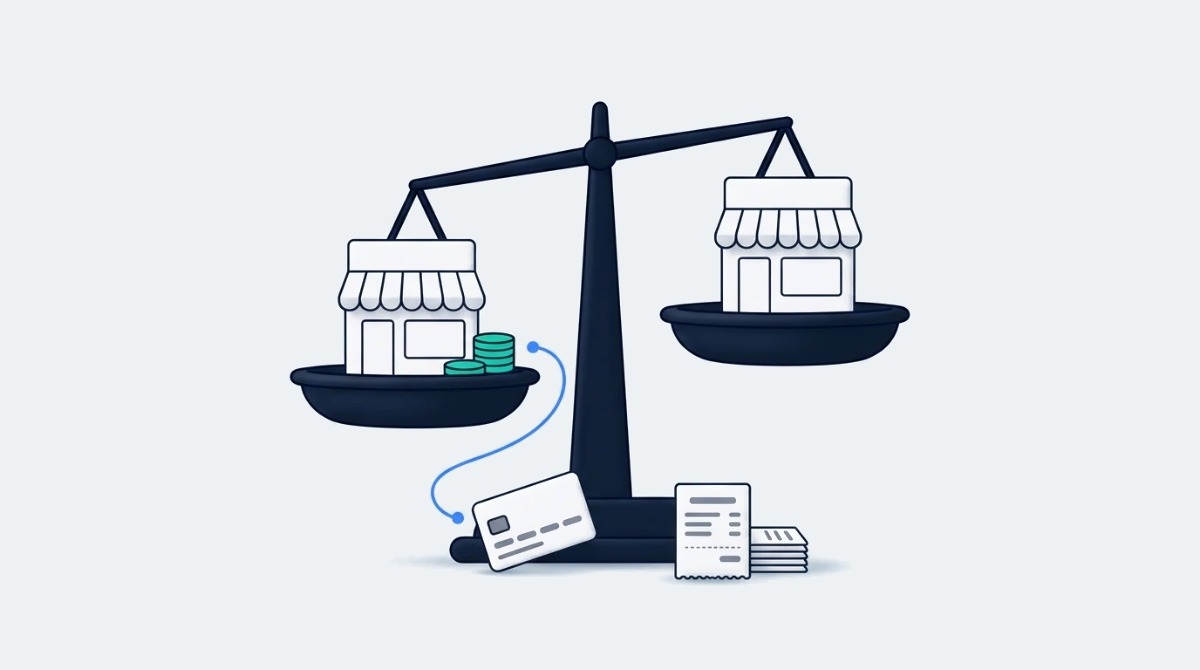
For years the BigCommerce pitch was simple: no transaction fees. Since its June 2026 plan change, that only holds if your processor is on its approved list, and the sales caps on its two cheapest plans dropped from $50K and $180K a year to $30K and $100K.
Let’s say you sell $25,000 a month online and you have two browser tabs open: Shopify’s pricing page and BigCommerce’s. Both show a $39 plan, a $105 plan and a $399 plan. They look like the same decision with different logos. They aren’t, and the reason changed this year.
Before going further, you should know where I stand. I spent just over six years at Shopify as a Senior Merchant Success Manager, at one point working with around 40 brands at a time, and I’m a member of the Shopify Partner Program and earn affiliate commissions from Shopify. When I sat down with Shopify’s retail lead Ray Reddy on episode 404 of the podcast, I told him “Shopify is the default install for retail.” I still believe that. So treat what follows as a comparison written by someone with a flag in the sand, who has done the arithmetic anyway and will tell you where the other side wins.
Starting June 1, 2026, BigCommerce renamed its self-serve plans, lowered the sales caps that trigger automatic upgrades, and added a fee on orders processed outside its approved payment list. According to BigCommerce’s own plan and pricing update, Standard became Core, Plus became Growth, Pro became Scale and Enterprise became Performance. Monthly plans moved on the next billing cycle; annual plans move at renewal. The monthly prices stayed at $39, $105 and $399, which is why a quick glance makes the two platforms look identical.
Three things underneath those prices moved. First, the caps. Core now tops out at $30K of trailing 12 month sales and Growth at $100K, down from $50K and $180K. Scale charges a 0.9% overage on sales above $33,333 a month and moves you to Performance once trailing sales reach $2M. Second, BigCommerce measures those caps in what it calls Inclusive GMV, which is your gross order value minus 10% (up from a 3% reduction before), so its number will not match your processor’s report. Third, a new Open Payment Provider Fee of 2.0% on Core, 1.0% on Growth and 0.6% on Scale applies to orders that run through a processor outside its list of 21 Embedded Payment Providers. Offline orders, such as purchase orders, count as outside volume too.
Here is how the published plans line up as of November 2026, on monthly billing.
The rates match, but the exemptions do not. On Shopify, Shopify’s fee rules waive the third-party fee for Shopify Payments, Shop Pay, PayPal Express Checkout and manual methods such as bank transfers, as long as Shopify Payments is active; any other card processor pays it. On BigCommerce, the 21 embedded providers are exempt, but offline orders are not. BigCommerce’s Performance plan is a quoted annual contract with no Open Payment Provider Fee under its terms.
Choose BigCommerce if you need a specific card processor, run several storefronts without enterprise pricing, or sell mostly B2B with workflows that fit its plans, because those are the places its design still beats Shopify’s.
Processor freedom is the clearest one. BigCommerce’s embedded list includes Stripe, Adyen, Checkout.com, Worldpay and PayPal Braintree, all with no platform fee, subject to each provider’s availability and underwriting in your market. If your business already has negotiated rates with one of those, or your category needs a processor that Shopify Payments will not support, BigCommerce lets you keep it without a penalty. On Shopify, an outside card processor carries the third-party fee on every plan. That is a real constraint, and it runs against something I believe about merchant independence.
Multiple storefronts is the second. BigCommerce’s pricing page lets you add storefronts on self-serve plans: up to 3 on Core at $30 a month each, 5 on Growth at $50 and 8 on Scale at $100. A brand running a retail site, a wholesale site and a regional site from one back office can do that without an enterprise contract.
B2B is the third, and it is where the parent company is placing its bets. On its third quarter 2026 earnings call, Commerce.com (formerly named BigCommerce) pointed to manufacturers and distributors, regulated retail, multilevel marketing and direct selling as its strongest pipeline. A parts distributor may find that focus useful.
Two caveats keep this honest. Price Lists for customer-specific B2B pricing sit on the Performance plan only. And on self-serve plans, purchase order and net-term orders count as outside volume, so a B2B seller on Growth or Scale pays the Open Payment Provider Fee on them, while Shopify waives its fee on manual payment methods when Shopify Payments is active. Compare your actual order workflows and quotes before assuming BigCommerce is the cheaper B2B home.
Choose Shopify if you are a DTC brand and you are comfortable running payments through Shopify Payments, because that combination gives you the lowest fees in the scenarios below and the largest ecosystem of apps, partners and sales channels.
The size difference is large. Shopify reported $119 billion in GMV for the third quarter of 2026 in its quarterly results release, while Commerce.com, across BigCommerce and its other businesses, reported $9.0 billion for the same quarter in its own results. Store Leads counts 33,880 apps in the Shopify App Store from more than 21,000 vendors. Size matters to you as a merchant for a practical reason: from what I watched inside Shopify and hear from agency partners now, new channels, AI shopping integrations and app categories tend to ship for Shopify first. That is my observation, not a measured rule.
B2B is less of a gap than it used to be. Shopify’s B2B features by plan now include companies, net payment terms, quantity rules and self-serve ordering on Basic, Grow and Advanced, with up to 3 active catalog assignments across your B2B markets. Customer-specific catalogs, deposits and partial payments still require Plus. For a DTC brand adding a wholesale channel, that is usually enough. For a distributor with hundreds of price agreements, it is not.
Now, the limitation, unsoftened. Shopify works best when you let Shopify run your payments. If your processor matters to you, or your category gets declined by Shopify Payments, the 0.6% to 2% third-party fee becomes a permanent tax. The second limitation is the ecosystem itself. A huge app store makes it easy to add a tool for every problem, and the merchants I talked with every week at Shopify, especially between $500K and $2M a year, more often stalled from too many apps than too few. The platform does not protect you from that.
At $300K a year, Shopify Basic costs about $360 a month less than BigCommerce, and at $1M a year Shopify Grow is about $836 a month cheaper, assuming US domestic cards at standard rates; the result only flips if BigCommerce processing falls below roughly 1.46% and 1.9% plus 30 cents.
Illustrative example, assuming monthly billing, flat sales every month, all orders online by US domestic card, an $80 average order, Shopify Payments on Shopify, and an embedded processor on BigCommerce at Stripe’s standard US rate of 2.9% plus 30 cents, chosen as one published benchmark. It counts subscription, overage and payment costs only, at published rates as of November 2026, and leaves out apps, annual billing discounts and first-year promotions.
Store A, $300K a year ($25,000 a month). On BigCommerce, $300K minus 10% is $270K of Inclusive GMV, well past Growth’s $100K cap, so Store A must be on Scale at $399. Processing adds $725 plus 30 cents on about 313 orders, or $94, for roughly $1,218 a month. On Shopify, Basic costs $39 plus 2.9% ($725) plus the same $94, roughly $858 a month. Grow comes out about $16 higher, so Basic is the right plan. Notice that processing is identical here. The whole $360 gap is the plan BigCommerce’s cap forces Store A onto.
Store B, $1M a year ($83,333 a month). On BigCommerce, Inclusive GMV is $75,000 a month, so Scale’s 0.9% overage applies to $41,667 above the $33,333 line. That is $375, putting the platform side at $774. Processing at Stripe’s standard rate adds about $2,729, for roughly $3,503 a month. On Shopify, Grow costs $105 plus 2.7% ($2,250) plus $313 in per-order fees, roughly $2,668 a month. Advanced lands at about $2,795, so Grow is still the cheaper plan here. About $669 of the $836 gap is plan price and overage; the rest is Shopify Grow’s lower card rate.
My read: the sticker prices match, but the bills don’t, because BigCommerce’s caps and overage push a growing store onto a bigger plan sooner. Your processing rate is the lever that can reverse that. Stripe and other processors offer custom pricing to larger merchants, so if you already pay meaningfully below standard rates on an embedded processor, rerun these numbers with yours before you decide. The break-even points between Shopify’s own plans are in my breakdown of when each Shopify plan upgrade pays for itself.
Before you commit, check where each company says its growth and investment are going, because a DTC brand wants a platform whose roadmap is aimed at DTC and a distributor wants one aimed at B2B.
On that third quarter call, CEO Travis Hess said “traditional B2C direct-to-consumer remains soft,” and the company described its strongest pipeline as B2B and regulated retail. Commerce.com also announced a plan targeting $60 million to $80 million in annualized cost reductions, its CFO and COO, Daniel Lentz, departed on November 13, and net revenue retention was 94.7%. It still grew GMV 14% year over year, reported $6.6 million in non-GAAP net income alongside a $3.2 million GAAP net loss, and its results release highlights continued investment in product intelligence and AI-driven agentic commerce. That reads to me as a company concentrating, not leaving DTC. It also suggests the next two years of product work will lean toward the B2B buyer.
Shopify reported GMV growth of 29% for the same quarter and has been extending B2B to its Basic, Grow and Advanced plans while building agentic commerce into the core platform. If you sell direct to consumers, I’d argue you want to be on the platform whose next two years of product work is aimed squarely at you.
The honest counterweight: a company narrowing its focus can serve that narrower group better. A distributor might reasonably prefer a platform reorganizing itself around distributors over one where B2B is one priority among many.
Stay on BigCommerce if your store is profitable and the platform does what you need; move only when the yearly savings or a missing capability clearly outweigh the one-time migration cost, and give the SEO work at least three months of lead time.
Run the payback test before anything else. Take the monthly difference from the math above, multiply by twelve, and set it against the quotes you get for design, development, data migration and the sales dip a replatform can bring. If the move takes more than a year or two to pay back and you aren’t missing a capability, staying is usually the better call.
Migration is the most expensive place to be wrong. Moving catalogs, customer accounts, order history and redirects is hard even when it goes well, which is why replatforms top the list in this Fastlane guide to what still needs an agency after Shopify’s Fall ’26 tools. Russ Macumber, Co-Founder and Managing Director of Impressive Digital, put the SEO timing plainly on episode 433: “ideally, depending on the size of the site, you kind of want to have that SEO lens on it at least three months before you’re going to go live.” Catalogs with heavy compatibility data are harder still; the fitment gap for automotive brands leaving BigCommerce shows where generalist migrations break.
Plenty of merchants do switch, in both directions. Store Leads’ BigCommerce report, updated November 20, 2026, detected 574 stores switching from BigCommerce to other platforms in its rolling 90 days, 338 of them to Shopify, and 105 switching from Shopify to BigCommerce. That shows a net direction, not proof the fee change caused it.
Two things reduce the pressure to move. If AI shopping channels are your reason, the Shopify Agentic plan lets an eligible BigCommerce store list products in Shopify Catalog for ChatGPT, Gemini and Copilot with no monthly fee, without replatforming. And if your problem is a large catalog that has outgrown its tools, fix the bottleneck first; my guide to BigCommerce apps for large catalogs covers which one to install for which problem. Sometimes the right answer is to do less, and not move at all this year.
The right platform changes by stage: below BigCommerce’s first cap the two cost the same on paper, through the Growing stage Shopify’s lower plan requirement wins, and from Scaling upward your processing rate and business model decide it.
If you’re Starting (pre-launch to $10K a month), the published costs are a tie until about $33K a year in gross sales: $39 a month on both, and no extra fee on either side if you use Shopify Payments or a BigCommerce embedded processor. Above that, BigCommerce moves you to its $105 Growth plan while Shopify Basic stays at $39. I’d pick Shopify for the size of its ecosystem and the number of people who can help you, but if you are already on BigCommerce and it works, don’t pay to migrate. Spend the energy finding one channel that works.
If you’re Growing ($10K to $100K a month), both worked examples sit in your band. Once you pass about $111K a year in gross sales, BigCommerce’s caps push you onto its $399 plan, while Shopify Basic or Grow carries you a long way. The exception is a brand whose wholesale side is already bigger than its DTC side.
If you’re Scaling ($100K to $1M a month), BigCommerce’s 0.9% overage applies to a growing share of your sales until you reach Performance at $2M a year, so rerun the math with your real monthly volume, payment mix and processing rate. If you have a negotiated rate well below standard on an embedded processor, several storefronts, or a B2B-first model, BigCommerce deserves a serious look. If not, Shopify is likely cheaper.
If you’re Leading ($1M+ a month), you are negotiating Plus or Performance contracts, and the published numbers here are only a starting point. Get both quotes, and weigh the roadmap as heavily as the price.
Whichever way you go, decide on the outcome first. Know what you want the platform to do for your business in two years, and let the fees and features follow from that.
BigCommerce is not cheaper than Shopify for a DTC store selling $300K or $1M a year at standard US card rates, based on published fees as of November 2026. In an illustrative example, the $300K store must use BigCommerce’s $399 Scale plan because of the lower sales caps, while Shopify Basic at $39 still fits, a gap of roughly $360 a month. At $1M a year, BigCommerce’s 0.9% overage widens the gap to about $836 a month against Shopify Grow. Below about $33K a year the two cost the same on paper. BigCommerce can win when you process through an embedded provider at a rate well below standard pricing, so rerun the numbers with your own rate.
BigCommerce no longer has zero transaction fees in every case: since its June 2026 plan change, it charges an Open Payment Provider Fee on orders processed outside its list of embedded providers. The fee is 2.0% on Core, 1.0% on Growth and 0.6% on Scale, and it also applies to offline orders such as purchase orders. Orders through the 21 embedded providers, which include Stripe, PayPal Braintree, Adyen and Worldpay, carry no platform fee. Shopify’s third-party fee uses the same rates on Basic, Grow and Advanced but exempts fewer card processors, mainly Shopify Payments, Shop Pay and PayPal Express Checkout when Shopify Payments is active.
You should switch from BigCommerce to Shopify only when the yearly savings or a capability you are missing clearly outweigh the one-time cost and risk of migrating. Start by calculating your monthly cost difference on both platforms, multiplying it by twelve, and comparing that with quotes for the migration and a possible short-term sales dip. Good reasons include a DTC business that needs apps or channels BigCommerce lacks, or fees that rise sharply under the new caps and overage. If AI shopping channels are the main draw, Shopify’s Agentic plan can list an eligible BigCommerce catalog without migrating. If you do move, bring in SEO help at least three months before launch.
BigCommerce can be the better fit for B2B-first businesses, but only after you compare your actual ordering workflows and quotes on both platforms. Its parent company is concentrating on manufacturers and distributors, and it supports more card processors without a fee. However, customer-specific Price Lists require its Performance plan, and purchase order and net-term orders on self-serve plans count toward its Open Payment Provider Fee. Shopify offers companies, net terms, quantity rules and up to 3 active catalog assignments on Basic, Grow and Advanced, with customer-specific catalogs and partial payments on Plus. A DTC brand adding wholesale usually does fine on Shopify.
Yes, an eligible BigCommerce store can list its products in Shopify’s AI channels without migrating by using the Shopify Agentic plan, which syndicates products through Shopify Catalog to assistants such as ChatGPT, Gemini and Copilot. The plan has no monthly fee. Your store stays on BigCommerce, each product needs a working page there, and you verify your domain and business details with Shopify. By default, shoppers are sent to your BigCommerce store to buy, where your current processor and its fees apply. Shopify-powered checkout inside the AI channel is off by default and carries its own processing fees if you turn it on. The main ongoing cost is keeping product data, prices and inventory in sync.